Entering Czechia As A US Visitor: Passports, ETIAS And Schengen Days
Brno, in South Moravia, Czechia, is inside the European Union and the Schengen Area, and for US citizens the entry rules are the Schengen rules: a valid passport, no visa for short stays, and a 90-day clock that counts every day spent anywhere in the zone.
Short answer
US citizens need a passport valid for at least six months beyond departure (three months beyond beyond the Schengen exit date is the treaty minimum, six is the safe margin) and can stay up to 90 days in any 180 in the Schengen Area without a visa. Czechia uses the koruna (CZK), not the euro.
Brno, in South Moravia, Czechia, is an inland city of 404,296 permanent residents (end of 2025) that belongs to two clubs that matter at the border: the European Union and the Schengen Area. For a US visitor that means no visa for a short stay, but it also means the days you spend in Brno sit on the same 90/180 clock as days spent in France, Italy, Germany or anywhere else in Schengen. Czechia keeps its own currency, the koruna (CZK), so the border formalities are European while the money in your hand is not. A US passport holder needs to know what is required before flying, what the day-count arithmetic actually says, where the ETIAS travel authorisation fits, and how the practical arrival into Brno works once you are through.
What Documents Do US Citizens Need To Enter Czechia For Brno?
US citizens enter Czechia with a valid passport alone: no visa is needed for tourism or business stays of up to 90 days in any 180-day period within the Schengen Area. The passport must be valid for at least three months beyond the planned date of departure from Schengen and issued within the last ten years. Border officers can also ask for proof of onward travel, accommodation and sufficient funds, so having those ready is part of the requirement in practice.
The three-months-beyond-departure figure is the treaty minimum that applies across the Schengen states. Many travel authorities advise six months of remaining validity, and the margin costs nothing: renew early and the question disappears. The ten-year rule on passport age matters for holders of older documents, because a passport issued more than ten years before arrival no longer satisfies the standard even if the expiry date looks fine.

Czechia sits inside Schengen together with its neighbours Austria, Slovakia, Germany and Poland, so once you have entered any Schengen country you cross into Czechia with no routine internal border check. A visitor who lands in Vienna or Prague and rides a train to Brno clears passport control once, at the first point of entry. Spot checks do happen on some cross-border trains and buses, and carrying the passport (not a copy) is the legal baseline everywhere in Czechia.
| Document | What The Rule Says | Notes For A Brno Trip |
|---|---|---|
| Passport | Valid 3 months beyond Schengen departure, issued within last 10 years | Six months of validity is the safe margin |
| Visa | Not required for US citizens up to 90 days in any 180 | Counts all Schengen countries together |
| ETIAS travel authorisation | A planned electronic pre-authorisation for visa-exempt nationals | Launch date had not been confirmed; check before booking |
| Return/onward ticket | Can be requested at the border | Have the confirmation reachable offline |
| Proof of funds and stay | Can be requested at the border | Hotel booking or address, plus a card or cash |
How Does The Schengen 90/180-Day Rule Work For A Brno Trip?
The rule allows 90 days of presence in any rolling 180-day window, counted across the whole Schengen Area, not per country. Each day you look back 180 days and add up every day spent in Schengen, including arrival and departure days: if the total is 90 or fewer you are legal, and the moment it would hit 91 you must have left. Time in Ireland, the UK, Croatia's non-Schengen neighbours and other non-Schengen states does not count.
The arithmetic catches out long-stay travellers, not weekend visitors. A ten-day trip to Brno with a Prague stopover uses ten days of the allowance whether you enter through Vienna Airport or Brno-Tuřany. A visitor who spends 60 days in Italy in spring and then plans 40 days in Czechia in autumn has a problem: the two stays overlap in the same window and exceed 90 together.
Border guards, airlines and the European travel-authorisation system do the counting from entry and exit stamps, which is why the stamps in your passport matter more than they look. The US-Czech pairing adds no bilateral extension: Czechia applies the uniform Schengen limit. A stay longer than 90 days needs a long-stay visa or residence permit applied for in advance through Czech channels, which is a different process from anything on this page.
| Trip Shape | Schengen Days Used | Legal Within 90/180? |
|---|---|---|
| 7 days in Brno only | 7 | Yes |
| 4 days Prague + 6 days Brno | 10 | Yes, counted across both |
| 70 days in Italy (spring) + 30 days in Brno (autumn) | 100 in one window | No, exceeds 90 |
| 3 long weekends spread across a year | 9 to 12 | Yes, windows rarely overlap |
For planning how a legal stay maps onto the city itself, the itineraries on two days in Brno and three days in Brno cover the ground a short trip can hold, and the question of how many days you need in Brno has its own answer page.
Will ETIAS Change Entry Requirements For US Visitors To Brno?
ETIAS is a planned electronic travel authorisation for visa-exempt visitors to the Schengen Area, and once it is live US citizens will need an online approval before boarding a flight or crossing into Schengen, in addition to the passport they already carry. It is not a visa: it is a pre-screening layer. Its start date had not been confirmed, so the only safe course is to check the official European information before booking travel.
The authorisation is designed to be applied for online, linked to the passport, and cheaper and faster than a visa. Until the system actually starts, entry for US citizens runs on the passport-plus-90/180 regime described above, and nothing else. Avoid any third-party site that charges a large fee to "register" you for ETIAS today: an authorisation that does not exist yet cannot be bought.

A parallel change, the Entry/Exit System (EES), will replace passport stamping with electronic registration of entries and exits at the external Schengen border. For a US traveller the practical effect is a slightly longer first border stop and no more stamps, whenever it begins. Neither system changes the 90/180 math, and neither changes the fact that Czechia is Schengen but keeps the koruna.
Which Airports And Routes Do US Visitors Use To Reach Brno?
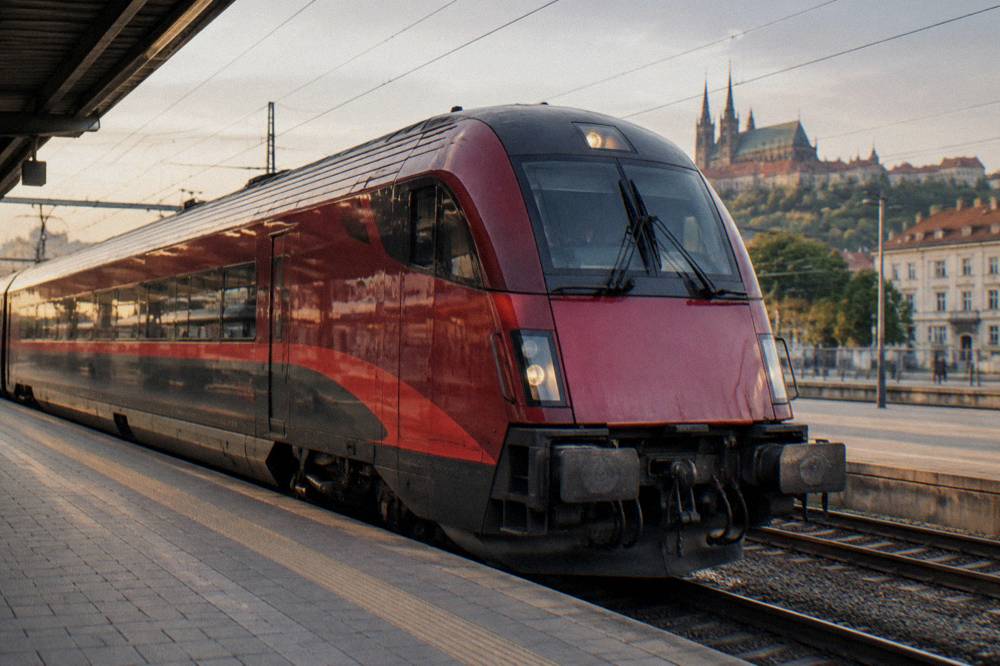
US travellers almost never land in Brno directly, because Brno-Tuřany (BRQ) is a small airport 8 km from the centre served by short-haul routes within Europe. The standard pattern is to fly into a major Schengen hub, Vienna or Prague, clear passport control there, and continue to Brno by train or bus: Vienna Hbf to Brno by direct Railjet takes about 1 h 31 min, and Prague to Brno takes 2 h 59 min by Railjet, per the operators' own schedules.
Vienna is the closer hub: about 111 km from Brno in a straight line, against Prague's 186 km. Buses from Vienna Airport to Brno take about 1 h 50 to 2 h 40 with fares from about EUR 10, per the aggregators listing them, and both RegioJet and FlixBus serve the route alongside the Vienna-Prague-Brno rail spine. Once in Czechia, Brno hlavní nádraží is the city's main station, and its own guide page covers the arrivals side.
| Route To Brno | Straight-Line Distance | Journey Time (As Listed) |
|---|---|---|
| Brno-Tuřany (BRQ) to city centre | 8 km | E76 bus about 20 min, 25 CZK |
| Vienna to Brno | 111 km | Railjet about 1 h 31 min |
| Vienna Airport to Brno (bus) | about 111 km to Vienna first | about 1 h 50 to 2 h 40, from about EUR 10 |
| Prague to Brno | 186 km | Railjet 2 h 59 min |
The detailed routings live on how to get to Brno, Vienna Airport to Brno, Prague to Brno and the Brno airport pages. Because the border formalities happen at the first Schengen airport, the transfer in Vienna or Prague is a domestic-style leg: no further passport check, only a platform change.
What Currency And Money Rules Apply Once You Are In Brno?
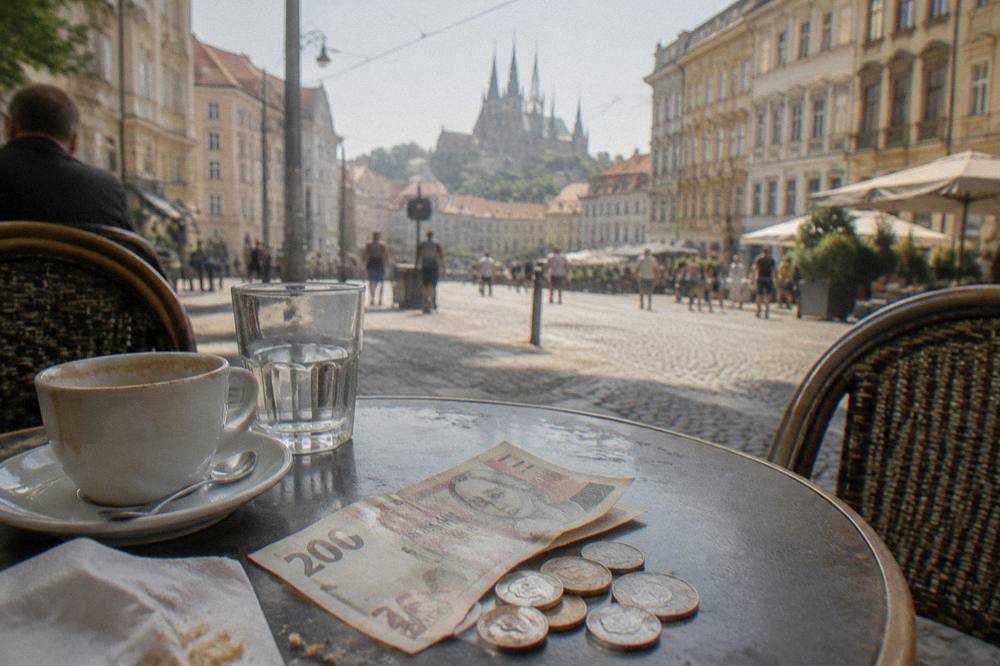
Czechia is in the European Union but not the eurozone: the currency is the Czech koruna (CZK), and every local price on this site, from tram tickets to castle admission, is quoted in koruna and never converted. Cards are widely usable in Brno, and the euro is sometimes accepted in tourist-facing shops, but relying on euro cash invites poor rates and change given back in koruna. Bank ATMs are the reasonable withdrawal choice.
The practical numbers a visitor touches first are small. A 60-minute public-transport ticket in Brno costs 25 CZK on paper (12 CZK reduced), a 90-minute ticket 33 CZK (16 CZK), and a 24-hour ticket for the city's two zones costs 90 CZK (45 CZK reduced), per the DPMB tariff valid from 1 October 2026. The Brnopas visitor card runs 370 / 490 / 610 CZK for one, two and three days, and its 3-day version includes free entry to a list of sights plus a seasonal reservoir boat. More of these guides are collected on Brno Travel Guide.
| Item | Price (CZK) | Notes |
|---|---|---|
| Tram/bus ticket, 15 min | 20 / 10 reduced | DPMB paper tariff from 1 Oct 2026 |
| Tram/bus ticket, 60 min | 25 / 12 reduced | City zones 100 + 101 |
| 24-hour Brno ticket | 90 / 45 reduced | Zones 100 + 101 |
| Brnopas 1 / 2 / 3 days | 370 / 490 / 610 | Free entry list on the card page |
| Old Town Hall tower | 90 adult / 50 reduced / 200 family | Sold only at the tower |
Tipping in restaurants runs 5 to 10 percent or a rounded-up total, per the Czech etiquette guides reporting on it. The koruna, the transport tariff and the card economics have a fuller treatment on the Brno public transport and Brnopas pages, and the money-and-museums side of a first visit is covered in what to do in Brno.
What Should US Visitors Know About Timing A Brno Trip Around Entry-Free Concerns?
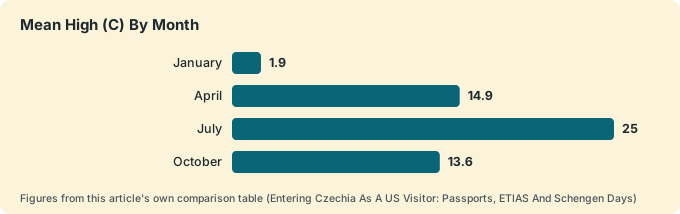
Entry rules do not change with the seasons, so the timing question is purely practical: the ERA5 reanalysis for Brno, 1991-2020, puts the July mean daily high at 25.0 C and the January mean daily low at -3.8 C, with July also the month with the most rain in the table at 82.8 mm of rain. A visitor's documents, the 90-day allowance and the koruna work identically in every month of the year.
What does shift is the calendar of events, and a couple of fixed anchors matter for planning. The MotoGP Czech GP ran 19 to 21 June 2026 at the Automotodrom Brno, and the Christmas markets ran 13 November to 31 December 2026. Neither changes a passport requirement; both change how early accommodation in the city needs booking.
| Month | Mean High (C) | Mean Low (C) | Rain (mm) |
|---|---|---|---|
| January | 1.9 | -3.8 | 33.6 |
| April | 14.9 | 4.5 | 40.4 |
| July | 25.0 | 15.3 | 82.8 |
| October | 13.6 | 6.3 | 43.5 |
The full monthly table, month-by-month guidance and the event calendar sit on Brno weather, the best time to visit Brno, the Brno Christmas market and the Masaryk Circuit MotoGP pages. One timing note that does touch tickets rather than borders: Villa Tugendhat, the city's UNESCO site, is entered only with a pre-booked ticket through Brno iD, is closed Mondays, and raises its prices on 1 January 2027, so its booking page should be part of the pre-departure checklist. The details are on the Villa Tugendhat tickets page.
Do You Need Anything Beyond Documents For Day Trips Around Brno?
No additional entry formalities apply to any day trip from Brno, because the Moravian Karst, Lednice-Valtice, Mikulov, Slavkov, Telč, Třebíč, Kroměříž and Olomouc are all inside Czechia and therefore inside Schengen with no internal borders. Vienna and Bratislava are also Schengen, so even the cross-border day trips involve no passport control, only the standard possibility of spot checks on cross-border transport.
The distances are short in straight-line terms: the Moravian Karst 20 km from the centre, Slavkov 20 km, Veveří Castle 13 km, Pernštejn 35 km, Mikulov 43 km, Lednice-Valtice 46 km, Olomouc 64 km and Vienna 111 km. Lednice-Valtice is a UNESCO landscape in its own right, alongside Telč, Třebíč and Kroměříž in the wider region, so a single 90-day allowance comfortably covers a city stay plus the surrounding heritage circuit.
Two ticket-side cautions travel with the day trips. Pernštejn Castle is seasonal, closed in winter and running weekend-only hours in autumn, so its opening page is worth a check before committing. The Punkva Caves in the Moravian Karst take bookings online in advance and the tour runs about 60 minutes with an underground boat, per the caves' own material. Neither is a border question, but both can end a day trip faster than any passport rule can.
What Everyday Rules Should A US Visitor Respect While In Brno?
Czechia is an EU member with ordinary European everyday rules: the emergency number is 112, tap water is drinkable, large shops close on certain public holidays by law, and identification in the form of the passport should be carried. The local taxes a visitor actually notices are small: the city's tourist tax is reported at 21 CZK per person per night under a city ordinance, normally collected through accommodation, and confirming it at booking avoids surprises.
Public transport is not free for visitors, and the tariff above applies; ticketless riding is fined. The cathedral's bells ring at 11:00 rather than noon, a local quirk tied to the 1645 siege, useful only for planning a listen. The Mendel Museum is closed Mondays and, from 1 October 2026, closes at 17:00, so its slot belongs early in an itinerary.
The practical arrival details, from the station area to where to base yourself, are laid out in the Brno train station, where to stay in Brno and Vienna to Brno guides. For the ground-level introduction to the city once the documents are back in the hotel safe, a private heritage walking tour pairs the entry checklist with an English-language first walk through Brno's story, and Check availability covers the operator's live listing.
Common Questions About Entering Czechia For Brno
Do US citizens need a visa for Brno?
No. US citizens can stay up to 90 days in any 180-day period anywhere in the Schengen Area, including Czechia, without a visa, using a valid passport.
What does the Schengen 90/180 rule mean?
At any moment, count every day spent in the Schengen Area in the previous 180 days, including arrival and departure days. The total must not exceed 90. The count is zone-wide, not per country.
Is ETIAS required now for US visitors to Czechia?
ETIAS is a planned electronic pre-authorisation for visa-exempt travellers. Its start date had not been confirmed, so check the official European information shortly before travel rather than relying on third-party registration sites.
Can I use euros in Brno?
Czechia uses the Czech koruna (CZK), not the euro. Cards are widely accepted and euros are sometimes taken in tourist-facing businesses, but expect poor rates and change in koruna.
Do I clear passport control in Brno if I fly via Vienna or Prague?
No. Vienna and Prague are both Schengen, so passport control happens once at the first Schengen airport. The onward leg to Brno, by train or bus, is an internal Schengen journey with no routine border check.
How long can a US citizen stay in Brno on one trip?
Up to 90 days within any rolling 180-day window across the whole Schengen Area. Longer stays require a long-stay visa or residence permit arranged in advance.