Why Is Brno Famous?
Brno is famous as Czechia's second city, the home of Villa Tugendhat, Špilberk Castle, the 11:00 cathedral bells and Gregor Mendel's peas. Here is what put South Moravia's capital on the map.
Brno, the inland capital of South Moravia in Czechia, is famous for a short but heavyweight list: a UNESCO-listed modernist villa, a castle that became an empire's prison, a cathedral whose bells ring an hour early on purpose, and a monk whose pea plants founded modern genetics. Add the second-largest city status in the country, the Brno Reservoir at its edge and a landscape of karst caves and vineyards within an hour, and the city's reputation starts to make sense. Each claim rests on the dates and figures the sources actually give.
Why Is Brno Famous?
Brno is famous as Czechia's second city and the historic capital of Moravia, a role it has held since 1641, and for five things no other city can claim together: Villa Tugendhat, inscribed by UNESCO in 2001, Špilberk Castle, turned into a Habsburg prison in 1783, the 11:00 bells of the Cathedral of Sts Peter and Paul, Gregor Mendel's heredity work published in 1865, and a functioning crocodile hanging in the Old Town Hall passage. Each of these is anchored to a date or an official listing, which is more than a lot of city fame can say.
To wander between them at your own pace, book a self-guided audio tour here.
The first written mention of Brno appears in the Kosmas Chronicle in 1091, and the city received its privileges in 1243 under Václav I. It grew into the administrative capital of Moravia in 1641 and held that role through the Swedish sieges of 1643 and 1645, when the city and Špilberk held out. For more on the city's standing today, see is Brno worth visiting, and for the rivalry angle, is Brno or Prague better to visit.
Why Is Villa Tugendhat Famous?
Villa Tugendhat, built 1928 to 1930 by Ludwig Mies van der Rohe, is famous as Brno's only UNESCO World Heritage Site, inscribed in 2001 with the reference number 1052, and as one of the defining works of modernist architecture. The interior can only be entered with a previously purchased ticket booked through Brno iD, the villa is closed on Mondays, and its prices rise on 1 January 2027, with the extended tour going from 500 to 550 CZK.
That ticketing regime is part of the fame as much as the architecture is. The villa's own booking page states that entry is online only via Brno iD, and reported demand is such that tours sell out quickly after release. The basic tour costs 450 CZK full fare until the end of 2026, then 500 CZK from 1 January 2027, and the extended tour covers the full building, the technical spaces and the garden. A shorter outside-and-garden tour is also listed.
The villa sits inside a wider story: Brno was a centre of functionalist architecture in the years around the building's construction, and the city's architecture walk is one of its quieter claims to fame. The why Villa Tugendhat is famous page carries the full detail, and a related design debate is covered in who designed the Brno chair.
Why Is Špilberk Castle Famous?
Špilberk Castle is famous as a fortress that became a Habsburg prison in 1783 under Joseph II, known as the prison of nations for holding political prisoners from across the empire, and as the stronghold whose defence kept the Swedish sieges of 1643 and 1645 out of the city. Its casemates are open to visitors, with a self-guided ticket at 190 CZK full fare and a guided Casemates tour at 260 CZK, per the castle's own ticket page.
The castle's own opening page lists the grounds open daily from 6:00 to 23:00, the ticket office daily 9:00 to 18:00, and the museum exhibitions, lookout, royal chapel and prism tower Tuesday to Sunday 10:00 to 18:00. The guided Story of the Castle tour costs 180 CZK full, 110 CZK reduced and 415 CZK for a family ticket, with booking through Brno iD. A new "Casemates War" section opened in the casemates in 2026.
The prison history is the part that travelled furthest.Converted in 1783, the fortress held prisoners from across the Habsburg lands, and the casemates themselves became the site's main draw. The full sight guide is at Špilberk Castle, and the combined castle-and-cathedral visit is covered in Špilberk and Petrov.
Why Do The Brno Bells Ring At 11:00?
The bells of the Cathedral of Sts Peter and Paul ring at 11:00 rather than noon because, by tradition, they recall the ruse that ended the Swedish siege of 1645: the story holds that the city rang an hour early and the besiegers, believing noon had come, broke off the attack and withdrew. The cathedral itself sits on Petrov Hill, where a Romanesque chapel of the 11th to 12th century stood, and the church appears on the Czech 10-crown coin.
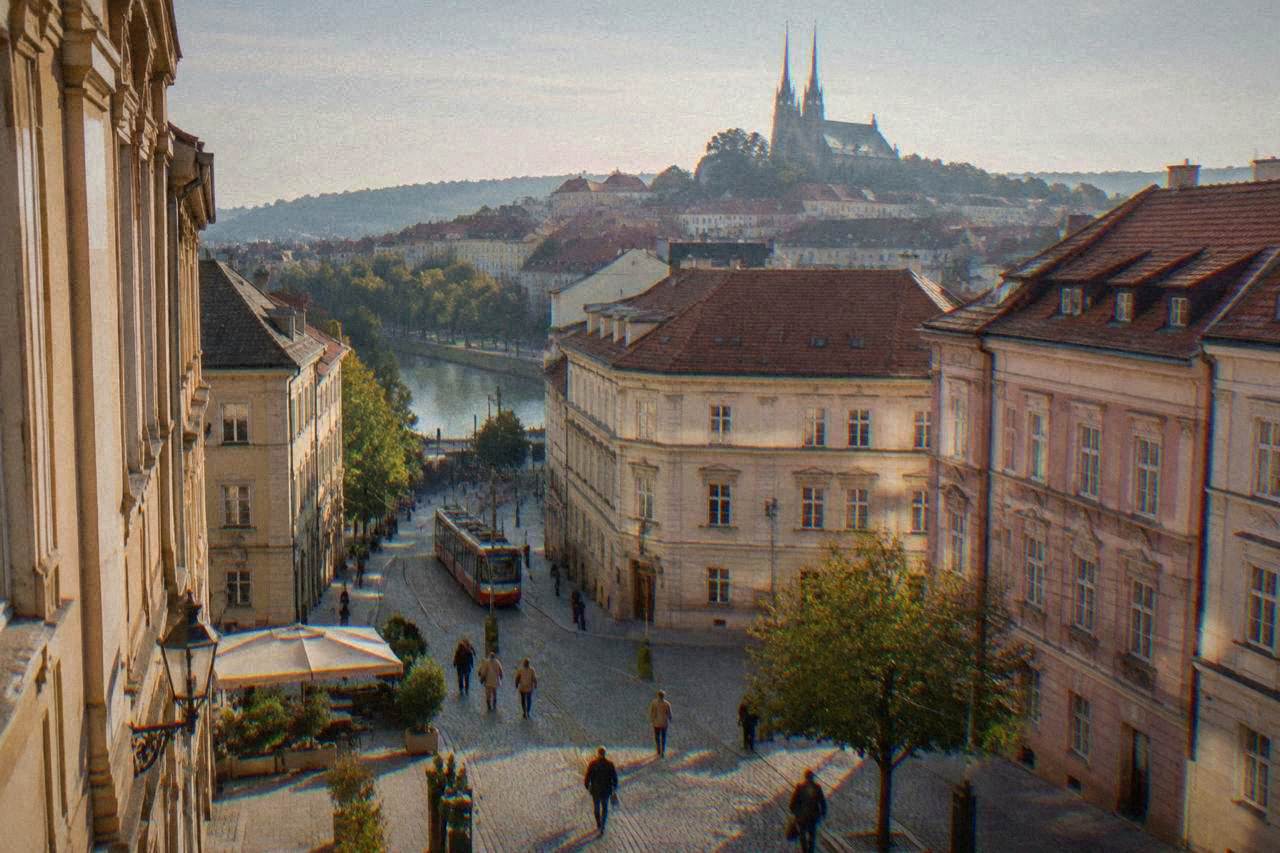
Go Brno, the city's official tourism site, tells the siege story on its cathedral page, and the 11:00 ringing is the living trace of it. The cathedral's twin spires define the city skyline from nearly every angle, and the hill itself is one of the two mounds, with Špilberk, that shaped Brno's medieval defences. The bell legend is standard material on the city's legend walks, which is where the Brno Legends & History Walking Tour (Tailored) fits in; the tour covers the dragon, the wheel and the siege stories that make up the city's folklore. Check availability.
The cathedral is also the anchor of a wider set of church sights; the churches of Brno guide lists the rest.
Why Is Brno Famous For Science?
Brno is famous in the history of science for Gregor Mendel, born in 1822, who worked at the Augustinian abbey in Old Brno and delivered the lecture, and published the paper, on pea-plant heredity in 1865, founding modern genetics. The Mendel Museum at the abbey is open Tuesday to Sunday, 10:00 to 17:00 since 1 October 2026, closed Mondays, with entrance listed by Go Brno at 40 to 100 CZK depending on the ticket type.
The museum sits at the abbey where Mendel ran the experiments, which makes it one of the few places in the world where a founding document of a science can be traced to a specific garden. The city's scientific and technical fame extends to the Brno Exhibition Centre, opened in 1928 with the Exhibition of Contemporary Culture, which still anchors the city's trade-fair calendar, and to Masaryk University, whose official statistics page lists 38,181 students. The student-city angle gets its own treatment in Brno the student city.
The dates below are the ones the sources give for the claims above.
| Date | What happened | Source basis |
|---|---|---|
| 1091 | First written mention of Brno (Kosmas Chronicle) | unesco-czech.cz |
| 1243 | City privileges granted under Václav I | unesco-czech.cz |
| 1641 | Brno becomes the capital of Moravia | unesco-czech.cz |
| 1643 and 1645 | Swedish sieges; the city and Špilberk hold | unesco-czech.cz, Wikipedia |
| 1783 | Špilberk converted to a Habsburg prison under Joseph II | Wikipedia |
| 1822 | Gregor Mendel born | unesco-czech.cz |
| 1865 | Mendel's heredity lecture and publication in Brno | unesco-czech.cz |
| 1928 | Brno Exhibition Centre opens | Wikipedia, BVV |
| 1928 to 1930 | Villa Tugendhat built by Mies van der Rohe | tugendhat.eu, UNESCO |
| 2001 | Villa Tugendhat inscribed by UNESCO (ref 1052) | whc.unesco.org |
What Is Brno Famous For In Food And Wine?
Brno is famous as the gateway to South Moravian wine country: the region around the city holds the Lednice-Valtice Cultural Landscape, inscribed by UNESCO with reference 763, and the Vinobraní wine festival ran in the city centre from 25 September to 3 October in 2026. The city's own food fame is narrower, the Brno dragon in the Old Town Hall is actually a crocodile specimen, and the wheel beside it hangs there on a 1638 legend about a wheelwright named Birk.
The crocodile and the wheel are the two objects the city is most photographed asking about, and why is there a crocodile in Brno gives the full story. On the plate, the region's dishes and Moravian wines carry the reputation rather than any single named restaurant, and the food Brno is known for page covers the specifics. The wine-country context is in South Moravian wine.
The city's event calendar adds two more famous fixtures: Ignis Brunensis, the fireworks festival at the Brno Reservoir, ran 30 May to 4 July in 2026, and the MotoGP Czech Grand Prix returned to the Automotodrom, held 19 to 21 June 2026 with the race on 21 June. A 2027 MotoGP date had not been announced on the official calendar.
Why Is Brno Famous As A Base For Day Trips?
Brno is famous as a base because an unusual cluster of sights sits in a tight radius: the Moravian Karst with the Punkva Caves about 21 km in a straight line from the centre, Macocha Abyss 22 km, Slavkov, site of the Battle of Austerlitz on 2 December 1805, 20 km, the Lednice-Valtice UNESCO landscape 46 km, and four more UNESCO sites, Telč, Třebíč, Kroměříž and the Lednice-Valtice area itself, all reachable as day trips.
The Punkva Caves tour runs about 60 minutes and includes a boat on the underground river to the base of Macocha Abyss, and the caves are booked online in advance; the train from Brno to Blansko takes 18 to 24 minutes. Pernštejn Castle, 35 km in a straight line, charges 260 CZK adult for its basic tour per its own admission page, but it is seasonal, with weekend-only autumn hours and a winter closure, so its calendar needs checking before a visit. The distances below are straight-line kilometres, computed from the site's places data.
| Day trip from Brno | Straight-line distance | Known for |
|---|---|---|
| Moravian Karst | 20 km | Protected karst landscape |
| Punkva Caves | 21 km | Underground boat tour |
| Macocha Abyss | 22 km | Sinkhole gorge, view from the rim |
| Slavkov (Austerlitz) | 20 km | Battle of 2 December 1805 |
| Pernštejn Castle | 35 km | Gothic fortress, seasonal hours |
| Mikulov | 43 km | Castle town below the Pálava hills |
| Lednice-Valtice | 46 km | UNESCO cultural landscape (ref 763) |
| Telč | 84 km | UNESCO historic centre (ref 621) |
| Třebíč | 53 km | UNESCO Jewish Quarter (ref 1078) |
| Kroměříž | 58 km | UNESCO castle and gardens (ref 860) |
| Vienna | 111 km | Railjet connection about 1 h 31 min, reported |
| Prague | 186 km | Railjet about 2 h 59 min |
The planning questions around this are their own pages: how many days do you need in Brno and is Brno worth a day trip from Prague.
What Else Should You Know About Brno's Fame?
Brno's fame also rests on numbers a visitor notices quickly: 404,296 permanent residents at the end of 2025, the second-largest city in Czechia, inside a South Moravian Region of 1,228,779 people, in a country that uses the Czech koruna, not the euro, and is part of the EU and Schengen. The city is inland, its water body is the Brno Reservoir, and its climate is continental, with a July mean daily high of 25.0 C in the ERA5 reanalysis for 1991 to 2020.
The Reservoir is where the Ignis Brunensis fireworks are fired from, and it carries the DPMB boat route between the Bystrc wharf and Veverská Bítýška, with a seasonal boat included free with the 3-day Brnopas city card. The Brnopas itself, at 370, 490 and 610 CZK for one, two and three days, bundles free entry to the Old Town Hall tower, the Ossuary, the Brno Zoo and the cathedral, which is one of the more efficient ways to see the famous list in a short stay. As the Brno Travel Guide homepage lays out, the full sight inventory runs far past the famous five.
Common Questions About Brno
Why Is Brno Famous?
Brno is famous as Czechia's second city and the capital of Moravia since 1641, for the UNESCO-listed Villa Tugendhat, for Špilberk Castle's history as an empire prison from 1783, for the cathedral bells that ring at 11:00, and for Gregor Mendel's heredity work published in 1865.
Is Brno A UNESCO City?
Brno has one UNESCO World Heritage Site inside the city: Villa Tugendhat, inscribed in 2001 with reference 1052. The surrounding region adds the Lednice-Valtice Cultural Landscape, Telč, Třebíč and Kroměříž.
What Is Brno's Most Famous Building?
Villa Tugendhat, built 1928 to 1930 by Ludwig Mies van der Rohe, is the city's UNESCO-listed landmark; Špilberk Castle and the Cathedral of Sts Peter and Paul on Petrov Hill are the two landmarks that define the skyline.
Why Do Brno's Bells Ring At 11:00?
By tradition, the early ringing recalls the ruse credited with ending the Swedish siege of 1645. The bells of the Cathedral of Sts Peter and Paul ring at 11:00 rather than noon.
What Is The Brno Dragon?
The Brno dragon is a crocodile specimen hanging in the Old Town Hall passage, one of the city's two symbols alongside a wooden cart wheel linked by legend to the wheelwright Birk in 1638.
Is Brno Famous For Wine?
Brno is the natural base for South Moravian wine country: the Vinobraní festival filled Náměstí Svobody from 25 September to 3 October in 2026, and the Lednice-Valtice and Mikulov wine districts sit 46 and 43 km away in a straight line.