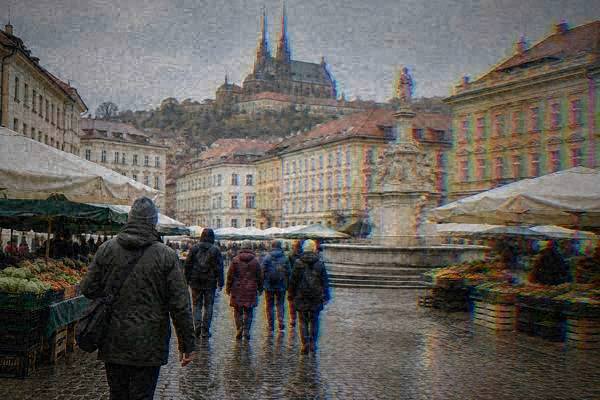
Brno Astronomical Clock: The Glass Bullet On Freedom Square
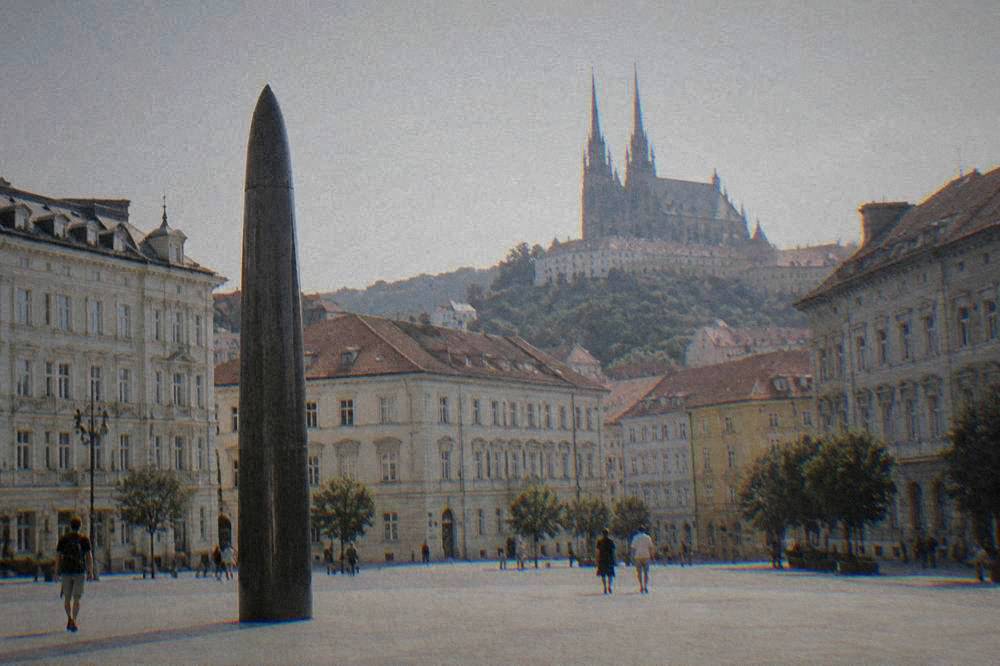
The astronomical clock on Freedom Square is one of the most talked-about pieces of public art in Brno, and it stands at the centre of a square ringed with legends, towers and ticketed sights.
Short answer
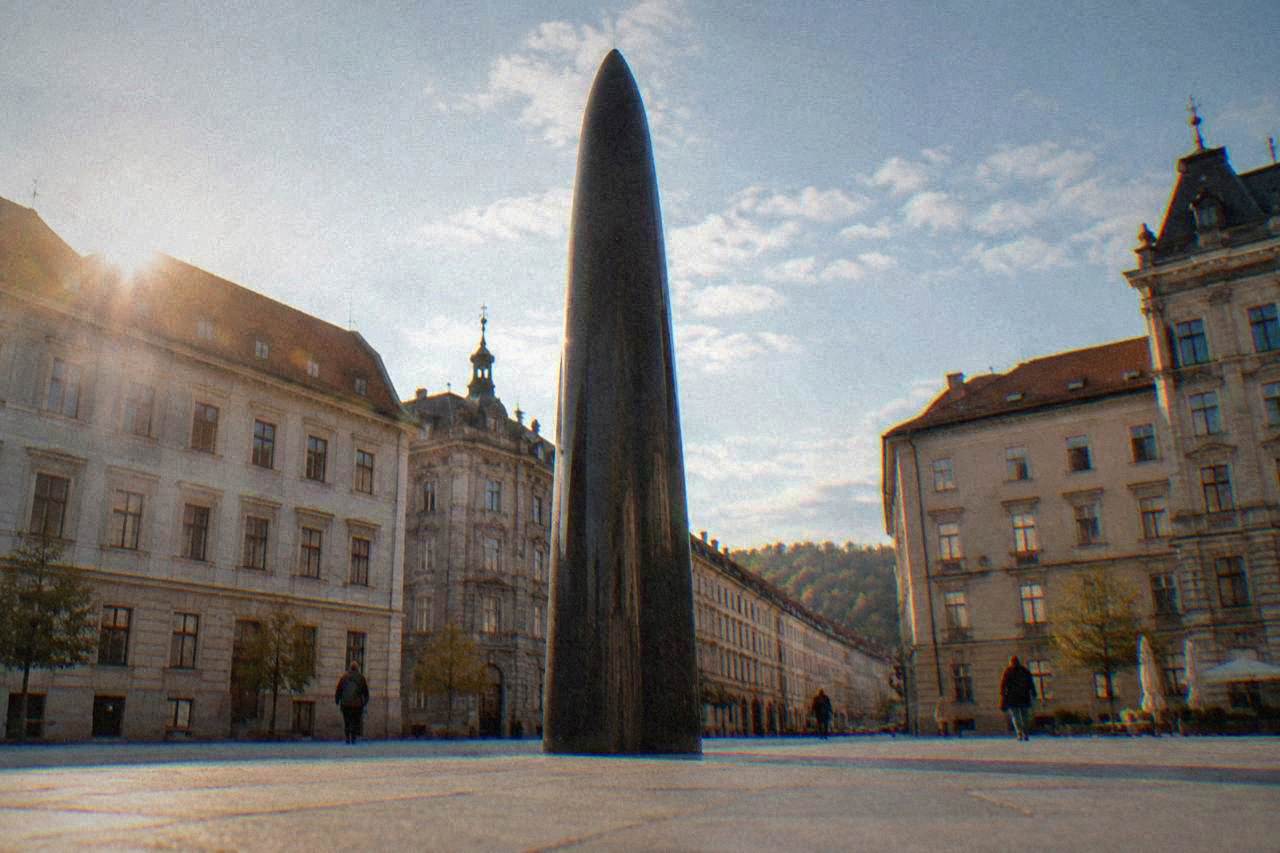
The Brno astronomical clock is a free, always-visible sculptural timepiece on Freedom Square (Náměstí Svobody) in central Brno, Czechia, a few minutes from the Old Town Hall, the Cabbage Market and Petrov. Its glass bullet is its famous feature, and the square around it can anchor a full day of sightseeing.
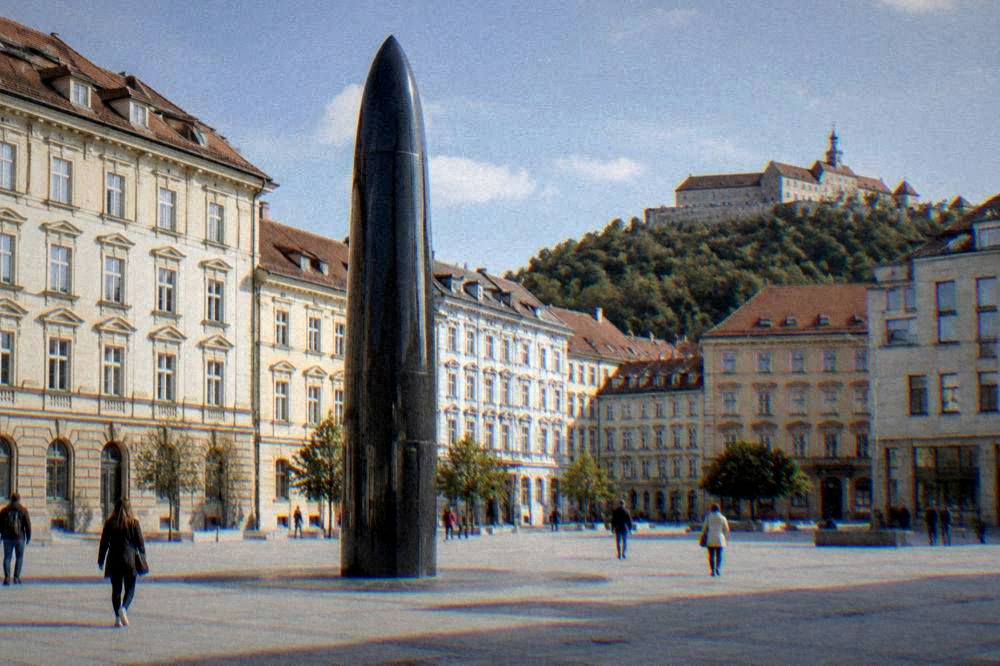
The astronomical clock on Freedom Square, Náměstí Svobody, is the piece of public art Brno argues about. It is a sculptural pillar that doubles as a timepiece, set in the paving of the city's best-known square, and its glass bullet has made it a fixture of every conversation about modern Brno. This page covers what it is, what can honestly be said about the bullet, the legends within a short radius of its base, and the priced sights around it, from the Old Town Hall tower to Špilberk Castle and Villa Tugendhat.
What Is The Brno Astronomical Clock?
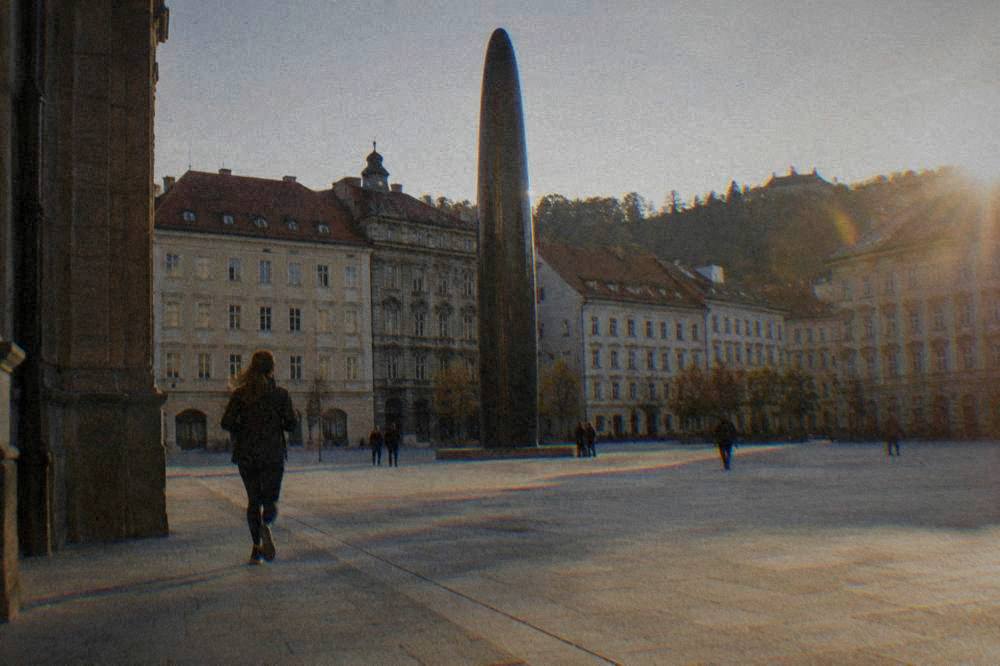
The Brno astronomical clock is a free public sculpture that functions as a clock, standing on Freedom Square, Náměstí Svobody, in the centre of Brno, an inland city of about 404,000 residents in South Moravia, Czechia. It is outdoors, unticketed and visible at any hour, and it sits in a square that also carries the city's Christmas markets and wine festival each year.
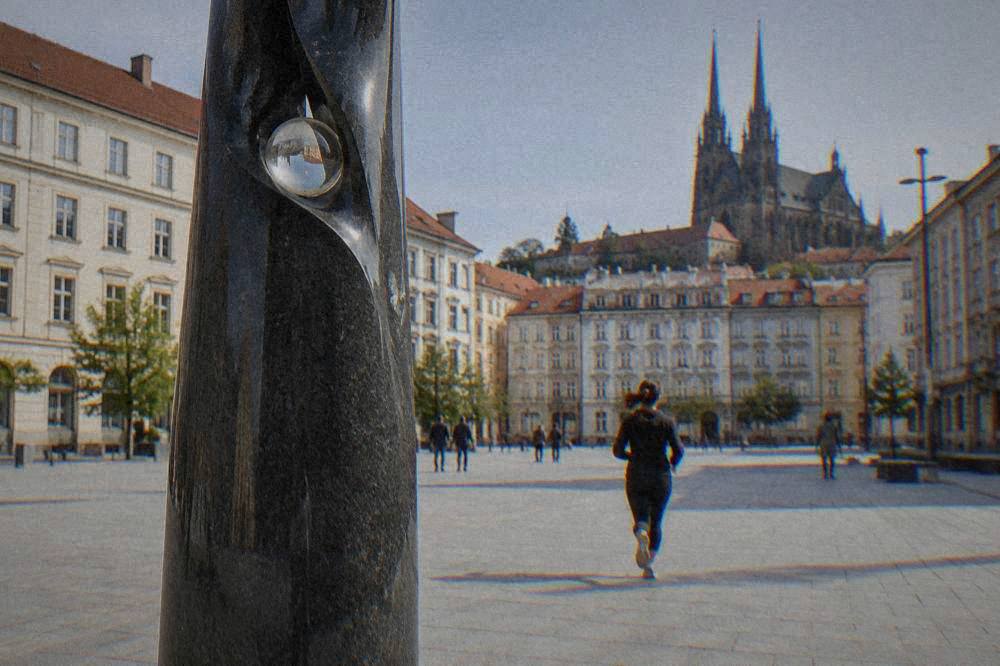
Unlike a classical astronomical clock with a painted dial and apostle figures, this one is a single monolithic form. The city's visitor materials list it among Brno's landmarks, and its glass bullet is the detail that made its reputation: a small glass sphere that is part of the work's design and its story. What can be stated with confidence ends there. The specifics of when and how the bullet is released are the kind of detail best confirmed on the spot or through the current city listings before you build a schedule around it. Treat the moment itself as something to witness rather than something to time your day around.
The clock belongs to a wider family of Brno oddities that reward a slow walk. The Brno Dragon hangs in the Old Town Hall passage a few streets away, the cathedral bells ring at 11:00 rather than noon, and an ossuary sits beneath the Cabbage Market. A city that puts a crocodile in its town hall was never going to install a conventional clock.
Where Does The Clock Stand On Freedom Square?
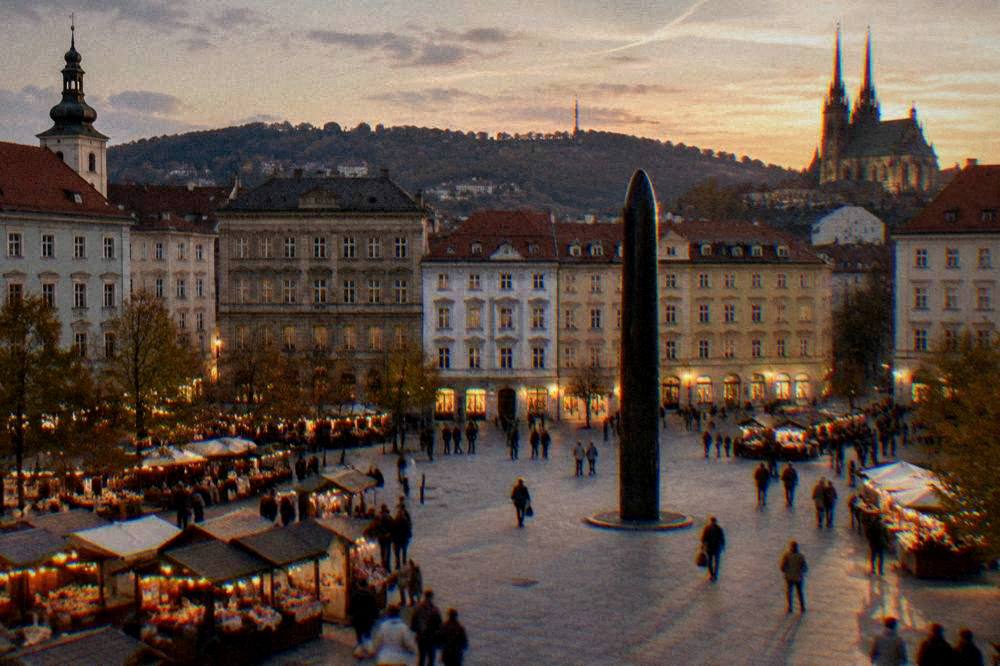
The clock stands on Freedom Square, Náměstí Svobody, the principal square of central Brno, and the square doubles as the city's main events ground: the 2026 Christmas markets ran there from 13 November to 31 December, and the Vinobraní wine festival ran 25 September to 3 October. Everything on the square is free to see from the paving.
The square is the natural spine of a first visit. It connects, on foot and without a ticket, to the Cabbage Market, Zelný trh, to the Old Town Hall and to the slope up to the Cathedral of Sts Peter and Paul on Petrov Hill. The Freedom Square guide on this site covers the square itself in detail, and the wider things to do in Brno round-up places it in a full itinerary.
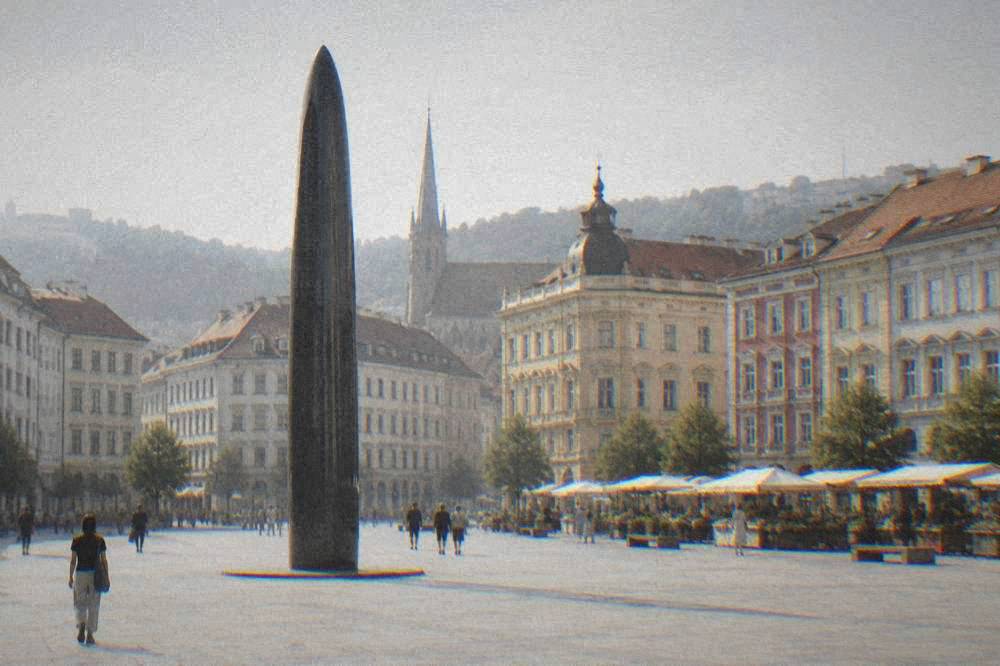
The square also hosts the city's annual festivals: Slavnosti Brno ran its Easter programme from 27 March to 5 April in 2026 and its May festival from 12 to 17 May. Both are annual events, so the 2026 dates show the shape of the year rather than a promise for the next edition.
What Does It Cost To See The Clock And The Sights Around It?
Seeing the clock itself costs nothing: it is a public sculpture on open paving. The paid sights around it are what shape a budget, and the Old Town Hall tower closest to it charges 90 CZK adult, 50 CZK reduced and 200 CZK family, with tickets sold only at the tower itself and free entry for Brnopas holders, per the city's visitor site.
From the square, the priced layers of Brno stack up quickly. Špilberk Castle, on its hill above the centre, charges 180 CZK full and 110 CZK reduced for the guided Story of the Castle tour and 260 CZK full, 155 CZK reduced for the guided Casemates tour, per the castle's own ticket page, with the self-guided Casemates at 190 CZK full. Villa Tugendhat, the city's UNESCO inscription of 2001, charges 450 CZK full for the Basic tour and 500 CZK for the Extended tour until 31 December 2026, rising on 1 January 2027, and every interior visit must be booked in advance through Brno iD. The Špilberk Castle and Villa Tugendhat pages on this site carry the full breakdown.
| Sight near the square | Full price (CZK) | Reduced (CZK) | Notes |
|---|---|---|---|
| Astronomical Clock, Freedom Square | 0 | 0 | Public sculpture, no ticket |
| Old Town Hall tower | 90 | 50 | 200 family, sold only at the tower, free with Brnopas |
| Špilberk, Story of the Castle (guided) | 180 | 110 | 415 family, tickets via Brno iD |
| Špilberk, Casemates (guided) | 260 | 155 | 600 family |
| Villa Tugendhat, Basic tour | 450 to 31 Dec 2026 | 270 | 500 full from 1 Jan 2027, booked via Brno iD, closed Mondays |
| Mendel Museum | 40 to 100 | range | Tue to Sun 10:00 to 17:00 from 1 Oct 2026, closed Mondays |
The Mendel Museum row is worth a second look: Gregor Mendel, born 1822, formulated his heredity theory with peas at the Augustinian abbey in Old Brno and published the work in 1865, so the museum fills out a day that starts at the clock with real scientific weight. Its hours changed on 1 October 2026 to 10:00 to 17:00, Tuesday to Sunday, closed Mondays.
Why Do The Cathedral Bells In Brno Ring At 11:00?
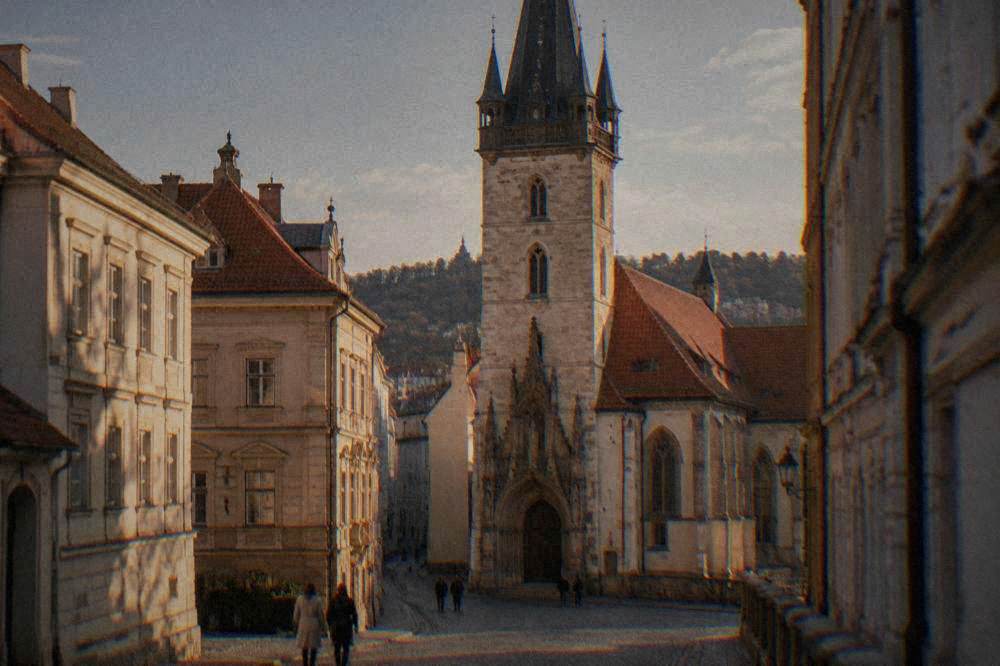
The bells of the Cathedral of Sts Peter and Paul in Brno ring at 11:00 rather than at noon, in memory of a ruse during the Swedish siege of 1645, when the city and Špilberk Castle held and the Swedish forces withdrew, per the city's visitor site. The cathedral stands on Petrov Hill, a short walk above the square, and the bell time is a daily piece of living history.
The story behind the bell is one of the best facts Brno offers. During the sieges of 1643 and 1645 the city held out, and the 11:00 ringing preserves the memory. The cathedral is also on the Czech 10-crown coin, and a Romanesque chapel on Petrov Hill dates to the 11th to 12th century, per the same source. A guided walk focused on the cathedral on Petrov Hill turns the legend into a route, and the operator's live listing covers current availability: Check availability.
What Are The Dragon And The Wheel Legends Near The Square?
The Brno Dragon, a crocodile specimen hanging in the Old Town Hall passage, and the giant wheel beside it are the city's two great legends, and both are free to view from the passage. The wheel is tied to a wager attributed to wheelwright Birk in 1638, a date carried by tradition, and the dragon and wheel together rank among the city's official symbols.
The Old Town Hall is only a few streets from the clock, so the dragon and the wheel slot naturally into the same walk. The tower above them charges its own admission, listed above, and the whole building is covered in the Old Town Hall guide. The legends matter to this page because the astronomical clock joined them: a city with a crocodile for a mascot and a bell that rings an hour early is exactly the city that would install a clock people argue about.
Is The Brno Astronomical Clock Worth The Detour?
For a visitor already in central Brno, the clock is not a detour at all: it sits on the main square of the city, it costs nothing, and it anchors a walk that takes in the dragon, the ossuary, the cathedral and the Cabbage Market within a compact historic core. As a single object it rewards five unhurried minutes; as the centre of a route, it rewards a full day.
The honest framing is this: nobody travels to Brno for the clock alone, and nobody in the centre can avoid it. Its value is as the hub of the Old Town. Below the Cabbage Market sits the Brno Ossuary, free with Brnopas, and the underground operator podzemibrno.cz also runs the Labyrinth under the Cabbage Market and the Capuchin Crypt; check the operator's page for hours and prices for those. The Cabbage Market itself is the historic market square a minute's walk from the clock.
Does The Brnopas City Card Cover The Sights Around The Clock?
Yes: the Brnopas city card includes free entry to the Old Town Hall tower, the Ossuary, the Brno Zoo and the cathedral tower among the sights on its list, and it costs 370 CZK for one day, 490 CZK for two and 610 CZK for three days at adult rate, per the official Brnopas page. A Brnopas+ variant bundles Villa Tugendhat at 870, 990 and 1110 CZK for one, two and three days.
Whether the card pays off depends on the pace of the visit. A day built around the clock, the tower, the Ossuary and the zoo will use the card hard; a slower visit centred on free squares and one castle tour may not. The three-day card also includes a seasonal boat on the Brno Reservoir, per the same page, and the reservoir itself is covered in the site's Brno Reservoir guide round-up context. Child rates run 250, 330 and 400 CZK for the standard card.
| Brnopas option | 1 day (CZK) | 2 days (CZK) | 3 days (CZK) |
|---|---|---|---|
| Adult | 370 | 490 | 610 |
| Child up to 15 | 250 | 330 | 400 |
| Brnopas+ with Villa Tugendhat, adult | 870 | 990 | 1110 |
| Brnopas+ with Špilberk water tanks, adult | 550 | 670 | 790 |
How Do You Get To Freedom Square By Public Transport?
Brno's trams and buses run on the IDS JMK network with the city in tariff zones 100 and 101, and paper tickets cost 20 CZK for 15 minutes, 25 CZK for 60 minutes and 33 CZK for 90 minutes at full rate, with a 24-hour Brno ticket at 90 CZK, per the DPMB tariff valid from 1 October 2026. Freedom Square sits in the centre, and any centre-bound tram lands within a short walk.
Tickets come from machines, kiosks, the driver or contactless payment on board, and the reduced paper rates are 10, 12 and 16 CZK for the same durations. An eight-trip ticket costs 156 CZK full. The airport bus E76 from Brno-Tuřany reaches Hlavní nádraží in about 20 minutes for 25 CZK, reported by the airport's own site, and the station is the natural rail arrival point for anyone coming by train, including the Railjet from Prague in 2 hours 59 minutes. More of these guides are collected on Brno Travel Guide.
| DPMB ticket | Full (CZK) | Reduced (CZK) | Validity |
|---|---|---|---|
| Paper, 2 zones | 20 | 10 | 15 minutes |
| Paper, 2 zones | 25 | 12 | 60 minutes |
| Paper, 3 zones | 33 | 16 | 90 minutes |
| 8-trip ticket | 156 | 78 | 8 single trips |
| 24-hour Brno (zones 100 + 101) | 90 | 45 | 24 hours |
Ride-hailing in Brno runs on Bolt; Uber does not operate in the city, per local reporting. Self-service luggage lockers are available 24/7 at Hlavní nádraží for anyone arriving with bags before check-in.
When Is The Best Time Of Year To See The Clock And The Square?
The ERA5 reanalysis for Brno, 1991 to 2020, puts the July mean daily high at 25.0 C and the January mean daily low at minus 3.8 C, with July also carrying the year's highest monthly rainfall at 82.8 mm and February the lowest at 27.9 mm. May, June and September combine mean highs of 19.2 to 22.9 C with less rain than July, which suits a walking day on the square.
The square changes character with the calendar. The 2026 Christmas markets ran from 13 November to 31 December, so late in the year the clock stands among wooden stalls, and the December mean high of 2.6 C argues for serious layers. The Vinobraní wine festival filled the square from 25 September to 3 October in 2026, and the Ignis Brunensis fireworks festival ran 30 May to 4 July at the Brno Reservoir, an inland body of water about 7 km from the centre in a straight line.
| Month | Mean high (C) | Mean low (C) | Rain (mm) |
|---|---|---|---|
| January | 1.9 | -3.8 | 33.6 |
| May | 19.2 | 9.6 | 65.8 |
| July | 25.0 | 15.3 | 82.8 |
| September | 19.5 | 10.8 | 64.2 |
| December | 2.6 | -2.4 | 36.4 |
All figures are ERA5 reanalysis values for the 1991 to 2020 period, a modelled grid cell rather than a weather station record. The site's Brno weather coverage carries the full monthly table.
What Day Trips Can Follow A Morning At The Clock?
The Moravian Karst lies about 20 km from the centre of Brno in a straight line, with the Punkva Caves at 21 km and Macocha Abyss at 22 km, and the train to Blansko takes 18 to 24 minutes, from where local transport covers the last stretch, reported by the caves' official material. A guided cave tour runs about 60 minutes and includes a boat on the underground river.
Beyond the karst, the day-trip ring is unusually rich for a city of this size. Lednice-Valtice, a UNESCO cultural landscape of 143 km2, sits about 46 km away, with Lednice Chateau charging 280 CZK for Tour I, 220 CZK for Tour II and 420 CZK combined, per the chateau's own site. Mikulov and the Pálava hills are 43 and 36 km out. Telč, Třebíč and Kroměříž, all UNESCO-listed, lie 84, 53 and 58 km away respectively, and Vienna is 111 km in a straight line, with a Railjet from Vienna Hbf reaching Brno in about 1 hour 31 minutes, per aggregator listings.
| Day trip from Brno | Straight-line distance | Notable fact |
|---|---|---|
| Brno Reservoir | 7 km | Inland reservoir, Ignis Brunensis venue |
| Moravian Karst | 20 km | Punkva Caves tour about 60 min with boat |
| Slavkov (Austerlitz) | 20 km | Battle fought 2 December 1805 |
| Pernštejn Castle | 35 km | Basic tour 260 CZK adult, seasonal opening |
| Mikulov | 43 km | Gateway to Pálava, 36 km from Brno |
| Lednice-Valtice | 46 km | UNESCO, Chateau Tour I 280 CZK |
| Telč | 84 km | UNESCO |
| Vienna | 111 km | Railjet about 1 h 31 min to Brno |
Pernštejn deserves its flag: the castle closes for winter, was shut from 3 November 2025 to 3 April 2026, and ran weekends only in October, so check its opening page before committing a day. The Telč and Olomouc pages on this site carry each trip in depth.
How Does The Clock Fit Into A Day Of Legends In Brno?
A single day can run from the astronomical clock on Freedom Square to the dragon and wheel in the Old Town Hall passage, up to the cathedral on Petrov for the 11:00 bells, across the Cabbage Market to the Ossuary, and finish at Špilberk Castle above the city, all on foot and with only the tower, underground and castle tickets to pay. The clock is the free anchor at the start of the chain.
The order is flexible, but the geography rewards a loop: square, passage, hill, market, castle. Anyone wanting the stories told rather than read can add a guided walk, and the Brno legends guide on this site unpacks the dragon and wheel in full. For a longer stay, the site's itinerary pages cover things to do in Brno across one, two or three days.
To hear those legends told as you walk, book a legends audio tour here.
Common Questions About The Brno Astronomical Clock
Does the Brno astronomical clock cost anything to see?
No. It is a public sculpture on the open paving of Freedom Square, visible at any hour without a ticket.
Where is the astronomical clock in Brno?
It stands on Freedom Square, Náměstí Svobody, the principal square of central Brno, a short walk from the Cabbage Market, the Old Town Hall and the climb to Petrov.
What is the glass bullet on the Brno clock?
The glass bullet is the small glass sphere that forms the clock's famous feature. The details of when and how it is released are best confirmed on the spot or via current city listings rather than planned around in advance.
What else is there to see near Freedom Square in Brno?
The Old Town Hall with the Brno Dragon and the wheel, the Ossuary and Labyrinth under the Cabbage Market, the Cathedral of Sts Peter and Paul on Petrov, Špilberk Castle and Villa Tugendhat, the city's UNESCO site since 2001.
Do the bells of Brno Cathedral really ring at 11:00?
Yes. The bells of the Cathedral of Sts Peter and Paul ring at 11:00 rather than noon, in memory of a ruse during the Swedish siege of 1645.
Is the Brno astronomical clock worth seeing?
As a free object at the heart of the Old Town, yes: it costs nothing, it sits on the city's main square, and it anchors a walk that takes in legends, towers, an ossuary and a cathedral within a compact centre.
The clock, the dragon, the wheel and the 11:00 bell add up to a city that tells its stories through objects, and Freedom Square is where the newest of those stories stands. Walk the square, look up at the pillar, then follow the legends downhill and uphill from its base; the rest of Brno's Old Town is within easy reach on foot.