Where Is Brno Located?
Brno sits in South Moravia, Czechia, an inland city on the Svratka and Svitava rivers, closer to Vienna than to Prague. Here is exactly where it is and how to get there.
Brno is an inland city in South Moravia, Czechia, standing on the Svratka and Svitava rivers. It is Czechia's second-largest city by population, with 404,296 permanent residents at the end of 2025, inside a South Moravian Region of 1,228,779 people. It is not the capital: Prague holds that role, 186 km away in a straight line. Vienna, by the same measure, is only 111 km from Brno, which shapes almost everything about how the city is visited, and this page sets out exactly where Brno sits and why that position matters. The team behind Brno Travel Guide lays out the coordinates, the distances and the practical consequences below.
Where Is Brno Located?
Brno is located in the South Moravian Region of Czechia, the Czech Republic, in the eastern half of the country and roughly 200 km southeast of Prague by air. It is an inland city with no coastline: the notable body of water nearby is the Brno Reservoir, about 7 km from the centre in a straight line. The city stands where the Svratka and Svitava rivers meet its territory, at the timezone Europe/Prague, inside the EU and the Schengen area.
Those are the bare coordinates, but the placement deserves a little more unpacking. Brno is the historic capital of Moravia, having become the region's main administrative capital in 1641, and Moravia itself is one of the historic lands of Czechia, not a separate country and not Slovak territory. The city's first written mention dates to 1091 and its city privileges to 1243, both recorded in the Czech UNESCO heritage history of Brno. So when a map search drops a pin somewhere between Prague and Vienna, that pin is landing on a city with a documented history stretching back nearly a millennium.
One point of confusion worth settling early: Brno has no sea and no lagoon. It is firmly inland, in the rolling landscape of South Moravia, a region that also holds the Pálava hills and the vineyards around Mikulov. The water that locals and visitors associate with the city is the Brno Reservoir, a lake on the Svratka northwest of the centre where DPMB boats run a route between the Bystrc wharf and Veverská Bítýška. Readers weighing the city against the capital can start with is Brno or Prague better to visit, and those deciding how long to stay should read how many days you need in Brno.
What Region Of Czechia Is Brno In?
Brno is in the South Moravian Region (Jihomoravský kraj), of which it is the seat, in the historical land of Moravia within Czechia. The region counted 1,228,779 residents on 30 June 2026, and Brno itself had 404,296 permanent residents at the end of 2025, making it the second-largest city in the country after Prague. Czechia uses the koruna, not the euro, despite being an EU and Schengen member.
Moravia is the eastern part of Czechia, and Brno sits close to its southern edge, which places the city nearer to two national borders than many visitors expect. Austria lies to the south and Slovakia to the east, and both are reachable without changing countries more than once. The question is Moravia Czech or Slovak comes up often enough to have its own answer on this site, and the short version is that Moravia is Czech, has been the eastern land of the Bohemian crown's successor state, and Brno has been its capital city since 1641.
The region's character follows from its position. South Moravia is wine country: the Pálava hills lie 36 km from Brno in a straight line, Mikulov 43 km, and the Lednice-Valtice Cultural Landscape, a UNESCO site since its inscription under reference 763, spans 143 square kilometres 46 km away. That concentration of wine and UNESCO-listed landscape within an hour of the city is a direct product of where Brno sits, and it shapes the Moravian wine tours from Brno covered elsewhere on this site.
How Far Is Brno From Prague, Vienna And Other Cities?
By straight-line distance from Brno's centre, Prague is 186 km away, Vienna 111 km, Bratislava 122 km and Olomouc 64 km. These are computed straight-line kilometres, not road or rail distances. The scheduled Railjet train between Brno and Prague runs 2 h 59 min, and the Railjet from Vienna Hbf reaches Brno in about 1 h 31 min, per the rail operators' own advertising.
The distances are the clearest way to understand Brno's pull. Vienna is the nearest major capital, closer by air than Prague is, and buses from Vienna Airport cover the run in about 1 h 50 to 2 h 40 with fares from about EUR 10, per the aggregators that list them. Prague, despite being the national capital, is a 2 h 59 min Railjet ride away, a connection detailed in how long is the train from Brno to Prague. Readers flying in can compare options in which airport is closest to Brno.
| Destination | Straight-line km from Brno centre | Scheduled connection on record |
|---|---|---|
| Brno-Tuřany Airport | 8 | E76 bus to Hlavní nádraží, about 20 min |
| Brno Reservoir | 7 | Local transport to the Bystrc wharf |
| Vienna | 111 | Railjet from Vienna Hbf, about 1 h 31 min |
| Bratislava | 122 | Bus and train services listed by RegioJet and FlixBus |
| Prague | 186 | Railjet, 2 h 59 min |
The table's distances are straight-line figures computed from the centre, and the connections are the ones the operators themselves advertise. Nothing in the card licenses a road distance or a drive time, so none is given.
What Rivers And Landscape Surround Brno?
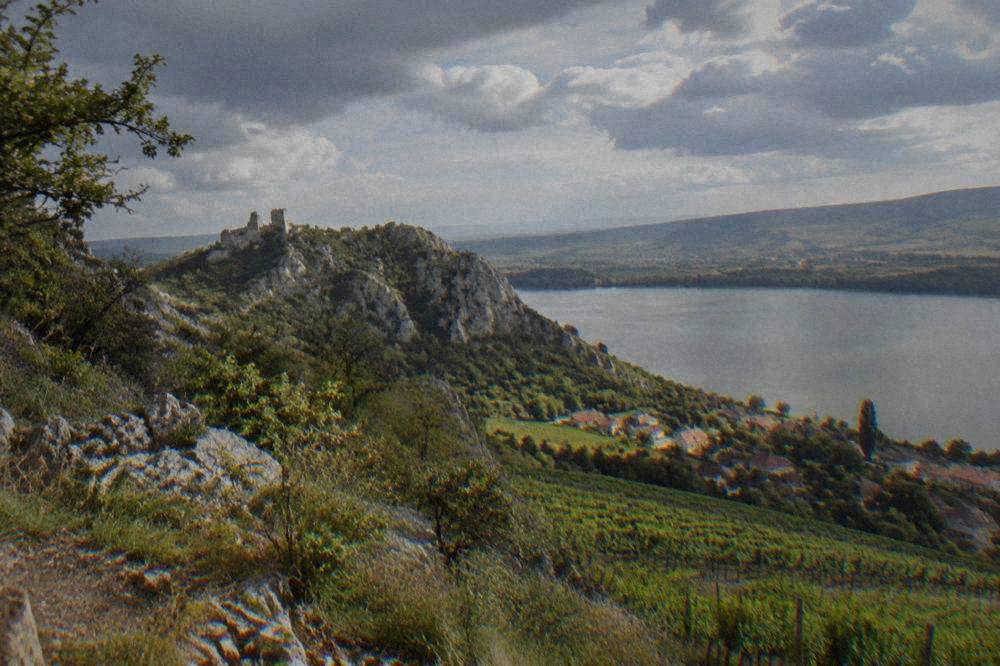
Brno stands on the Svratka and Svitava rivers, two watercourses that cross the city's territory before joining north of the centre, and the surrounding landscape is the wooded hills and karst country of South Moravia. The Moravian Karst begins about 20 km away in a straight line, with the Punkva Caves at 21 km and the Macocha Abyss at 22 km. The Brno Reservoir lies 7 km from the centre.
The karst is the headline geographical fact. The Moravian Karst, a protected landscape of limestone gorges and caves, sits on Brno's northern doorstep, and its two famous features, the Punkva Caves with their underground boat run and the Macocha Abyss, are close enough that the train from Brno hlavní nádraží to Blansko takes 18 to 24 minutes. That proximity is why Moravian Karst tours from Brno are a standard day out rather than an expedition. Further afield, castles ring the city: Veveří stands 13 km away on the Svratka above the reservoir, and Pernštejn, seasonal and closed over winter, lies 35 km distant.
Climate follows the geography. The ERA5 reanalysis for Brno, 1991-2020, puts the July mean daily high at 25.0 C and the January mean daily low at -3.8 C, with July also carrying the year's largest rainfall total at 82.8 mm and February the smallest at 27.9 mm. Annual precipitation sums to 617.6 mm across the modelled grid cell. That is a continental central-European pattern: warm summers, cold winters, and rain spread through the growing season, which suits the vineyards to the south. Readers curious about winter conditions can read does it snow in Brno.
Where Exactly Does Brno Sit On A Map Of Europe?
On a map of Europe, Brno sits in the very centre of the continent's northern half, in the eastern Czech Republic, southeast of Prague and north of Vienna. Vienna lies to its south, Bratislava to its southeast, Prague to its west and the Ostrava region to its northeast. The city's timezone is Europe/Prague, one hour ahead of Greenwich Mean Time in winter.
Central Europe is a loose phrase, but Brno earns it literally. Draw an arc from Vienna through Bratislava to Brno and Olomouc and you have traced the corridor where Austria, Slovakia and Czechia meet, all inside the Schengen area with no internal border checks. That makes Brno a practical base for three-country travel: Vienna at 111 straight-line km, Bratislava at 122, and the Slovak border closer still. The city's own airport, Brno-Tuřany, sits 8 km from the centre, with the airport's public transport page listing an E76 bus to the main station in about 20 minutes; many visitors instead arrive through Vienna or Prague, a comparison the site covers in Vienna airport to Brno.
The rail geography matters too. Brno hlavní nádraží, the city's main station, is the node where the Prague, Vienna and Bratislava lines converge, and RegioJet and FlixBus both serve the city with connections toward Vienna Airport, Prague, Bratislava and Olomouc. A new main station is in design, with a tender issued in October 2026 and construction not expected to start until after 2032, per regional reporting. For arrival logistics, the practical details are in how to get to Brno.
Why Does Brno's Location Matter For Day Trips?
Brno's location makes it one of central Europe's most productive day-trip bases: five UNESCO World Heritage sites or landscapes lie within roughly 90 straight-line kilometres, and the Moravian Karst is barely 20 km from the centre. Lednice-Valtice is 46 km, Třebíč 53, Kroměříž 58 and Telč 84, while Mikulov and the Pálava hills sit at 43 and 36 km.
No other Czech city of comparable size has this ring around it. Vienna and Bratislava function as international day trips from Brno the way other cities' second towns do, and the UNESCO cluster in South Moravia is dense enough that the region holds Lednice-Valtice (reference 763), Telč (621), Třebíč (1078) and Kroměříž (860) alongside Brno's own Villa Tugendhat (1052, inscribed 2001). The Austerlitz battlefield at Slavkov, site of the battle of 2 December 1805, is 20 km away. For the battle's location question specifically, see where was the Battle of Austerlitz fought.
| Day trip from Brno | Straight-line km | Note |
|---|---|---|
| Moravian Karst | 20 | Punkva Caves 21 km, Macocha Abyss 22 km |
| Slavkov (Austerlitz) | 20 | Battlefield of 2 December 1805 |
| Pálava hills | 36 | Protected landscape, hiking |
| Mikulov | 43 | Castle town below Pálava |
| Lednice-Valtice | 46 | UNESCO, park entry free, chateau tours 220 to 420 CZK |
| Třebíč | 53 | UNESCO Jewish Quarter and basilica |
| Kroměříž | 58 | UNESCO gardens and castle |
| Telč | 84 | UNESCO historic square |
Guided options cover the same ground. The Check availability link sits beside this site's own page for the private historic gems walking tour for the city core itself, while the Karst and the wine country have dedicated tour pages elsewhere on the site.
Common Questions About Brno's Location
Where Is Brno Located?
Brno is located in South Moravia, Czechia, an inland city on the Svratka and Svitava rivers, 186 km from Prague and 111 km from Vienna in straight-line kilometres. It is the seat of the South Moravian Region and Czechia's second-largest city.
Is Brno near Vienna or Prague?
By straight-line distance, Vienna is nearer: 111 km from Brno's centre against 186 km to Prague. The Railjet from Vienna Hbf takes about 1 h 31 min, while the scheduled Railjet to Prague runs 2 h 59 min.
Is Brno on the sea?
No. Brno is inland. The notable water body is the Brno Reservoir, about 7 km from the centre, where boats run between the Bystrc wharf and Veverská Bítýška on the Svratka.
Is Brno the capital of Czechia?
No, Prague is the capital of Czechia. Brno is the capital of the South Moravian Region and the historic capital of Moravia, a role it has held as the region's main administrative capital since 1641.
What country is Moravia in?
Moravia is in Czechia, together with Bohemia and Czech Silesia one of the historic lands of the country. Brno is Moravia's principal city, and the South Moravian Region around it held 1,228,779 residents on 30 June 2026.
What timezone is Brno in?
Brno is in the Europe/Prague timezone, the same as Prague and Vienna. Czechia is an EU and Schengen member but uses the Czech koruna rather than the euro.
The short version: Brno is an inland South Moravian city, closer to Vienna than to Prague, ringed by karst, castles and four UNESCO landscapes, and reachable by rail from three capitals. For whether the city rewards the journey, is Brno worth visiting has the fuller answer.