Is Moravia Czech Or Slovak?
Moravia is a historic region of Czechia, not Slovakia, and Brno is its largest city. A clear answer, with borders, distances and what it means for travellers.
Brno, the city this site is about, sits in South Moravia, in Czechia (the Czech Republic), an inland city of 404,296 permanent residents at the end of 2025. Moravia is the historic region that fills the eastern half of Czechia, and Slovakia is a separate country that begins about 122 km east of Brno in a straight line, at a national border both states share inside the Schengen area. The confusion is understandable, because the two were one country within living memory and the languages are close. The answer, though, is clean: Moravia is Czech, and it has been Czech territory since Czechia and Slovakia went their separate ways in the split of the joint state.
Is Moravia Czech Or Slovak?
Moravia is a historic region of Czechia, not of Slovakia. It forms the eastern part of the Czech Republic alongside Bohemia in the west and Czech Silesia in the north east, and its largest city is Brno, home to about 404,000 people. Slovakia is a sovereign state with its own capital, Bratislava, lying beyond Czechia's eastern border, roughly 122 km from Brno in a straight line. Until the two nations went their separate ways, they shared one country, which is where the confusion comes from.
The joint state, Czechoslovakia, split peacefully in what is commonly called the Velvet Divorce. When it did, every piece of Moravian territory stayed on the Czech side of the new line. Nothing about Moravia's identity changed hands: the same region, the same cities, the same dialects remained inside the Czech state. Today the phrase "South Moravian Region" refers to an administrative unit of Czechia with 1,228,779 residents as of 30 June 2026, and Brno is its seat.
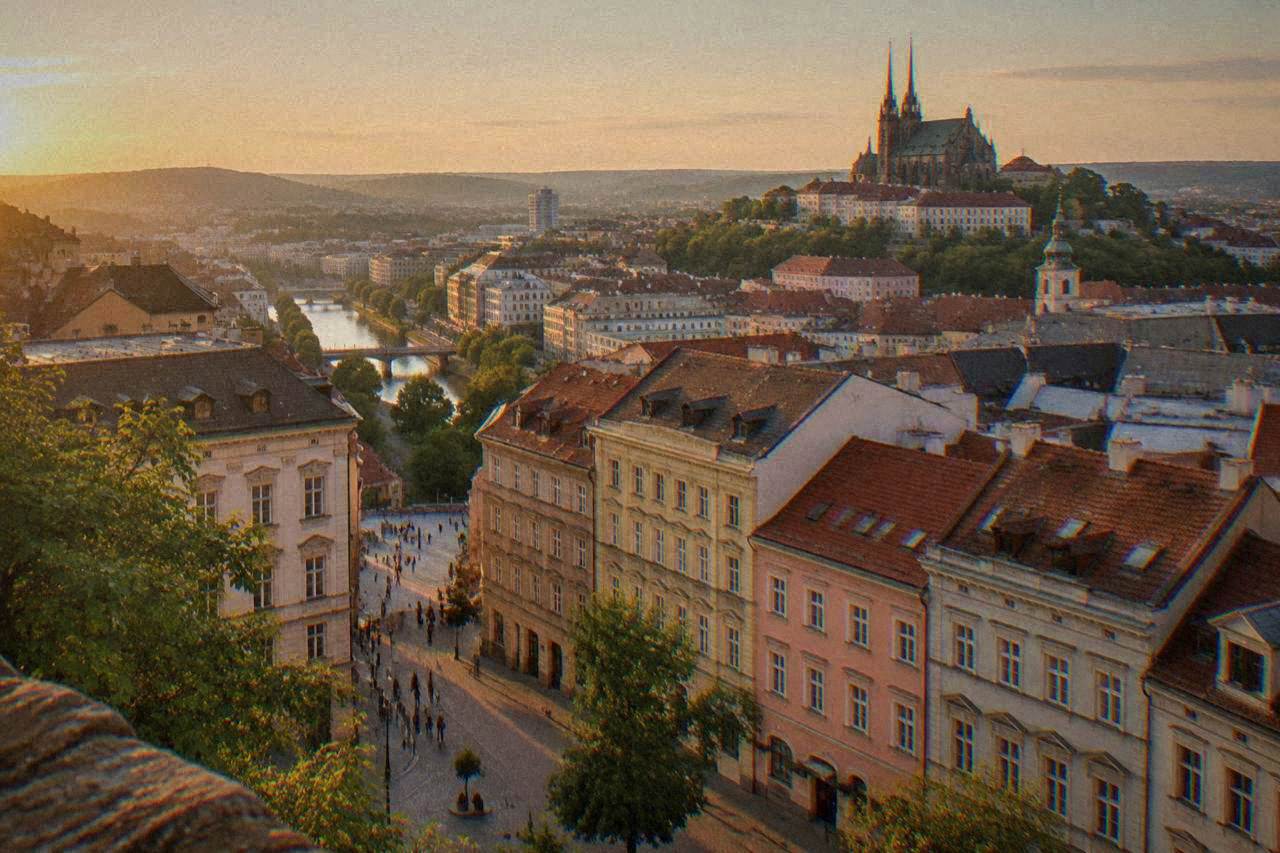
Brno's own history is Moravian history. The city's first written mention dates to 1091 and its city privileges to 1243, and from 1641 it served as the main capital of Moravia, a role reported by the Czech UNESCO heritage portal. That is why a traveller asking about Moravia usually ends up in Brno: the city is the region's practical gateway, with the airport, the main railway node and the bulk of its accommodation. For more on the city's standing among Czech destinations, see is Brno worth visiting.
Where Does Moravia Sit On The Map, Relative To Brno?
Moravia stretches east and south east of Brno all the way to the borders with Slovakia and Austria, and Brno sits near its western edge. Straight-line distances from the city centre to signature Moravian places run about 20 km to the Moravian Karst, 43 km to Mikulov, 46 km to the Lednice-Valtice landscape and 53 km to Třebíč, with Olomouc, another Moravian city, about 64 km away. Bratislava, in Slovakia, is about 122 km from Brno, and Vienna about 111 km.
Those figures are straight-line kilometres, computed from coordinates rather than road distances, but they show the geometry clearly. The Moravian places a visitor hears about, the karst caves, the Pálava hills, the wine country around Mikulov, the UNESCO sites at Lednice, Telč, Třebíč and Kroměříž, all sit on the Czech side of the line. Vienna and Bratislava are both closer to Brno than Prague is, which is why this site treats them as day-trip territory rather than distant capitals.
| Place | Straight-line distance from Brno | Country |
|---|---|---|
| Moravian Karst | about 20 km | Czechia |
| Mikulov | about 43 km | Czechia |
| Lednice-Valtice landscape | about 46 km | Czechia |
| Třebíč | about 53 km | Czechia |
| Kroměříž | about 58 km | Czechia |
| Olomouc | about 64 km | Czechia |
| Telč | about 84 km | Czechia |
| Vienna | about 111 km | Austria |
| Bratislava | about 122 km | Slovakia |
The border with Slovakia is not visible on this list because none of the classic Moravian destinations reach it. That is the practical test of the answer: a week of day trips from Brno through Moravia keeps a traveller entirely inside Czechia, paying in Czech koruna, riding Czech trains and reading Czech signage. Slovakia is a further hop, and a different country altogether.
Why Do People Confuse Moravia With Slovakia?
The confusion comes from decades of shared statehood: through the Czechoslovak era Moravia and Slovakia were parts of one country, with one government, one passport and, for much of that time, one currency. The two languages, Czech and Slovak, are closely related and remain mutually intelligible, so place names and surnames on both sides sound similar. Since the split, however, Moravia has been Czech territory in every legal, administrative and currency sense.
Even the joint name held a clue. "Czecho" covered the Czech lands, Bohemia, Moravia and Czech Silesia, while "slovakia" covered the eastern state. When the federation divided, the border was drawn between the two halves, and Moravia fell entirely on the Czech side. The split was agreed by the parliaments of both republics and took effect without a referendum or any transfer of Moravian land.
For a traveller the practical differences are easy to state. Czechia uses the Czech koruna (CZK) and is in the EU and the Schengen area; Slovakia is also in both, so no border checks separate the two, but the countries issue their own currency and run their own railways. Nothing on this page's itinerary changes: Brno, its castle, its UNESCO villa and its wine country are all Czech, in the fullest current meaning of the word. The question of how the city stacks up against the capital is covered separately in is Brno or Prague better to visit.
What Does Moravia Offer Within Reach Of Brno?
Moravia's headline sights ring Brno at day-trip distance: the Moravian Karst with the Punkva Caves about 20 km away, the Lednice-Valtice Cultural Landscape, a UNESCO site of 143 square kilometres, about 46 km, the wine hills of Pálava and Mikulov about 36 to 43 km, and further UNESCO entries at Třebíč, Kroměříž and Telč. The region is also wine country, which distinguishes it from beer-focused Bohemia, and the Lednice chateau's own site lists Tour I at 280 CZK full and 200 CZK reduced.
To see the karst and the wine hills in one outing, book a South Moravia day trip here.
| Sight | Verified entry figures | Notes |
|---|---|---|
| Lednice Chateau, Tour I | 280 CZK full, 200 CZK reduced | per the chateau's official site |
| Lednice Chateau, Tour II | 220 CZK full, 160 CZK reduced | private apartments circuit |
| Lednice Chateau, combined ticket | 420 CZK full, 300 CZK reduced | both circuits |
| Lednice park | free entry | year round, per the official site |
| Pernštejn Castle, basic tour | 260 CZK adult, 210 reduced, 80 child | seasonal opening, check before going |
The Lednice-Valtice area is the region's showcase: a UNESCO-inscribed cultural landscape of 143 square kilometres in South Moravia, listed under reference 763, where a chateau, a park and a network of designed vistas spread across flat, wine-growing country. Pernštejn Castle, another Moravian landmark about 35 km from Brno in a straight line, charges 260 CZK for its basic tour per the castle's own admission page, and it closes for winter, so its opening calendar matters more than its price list when planning a visit.
Wine is the region's other signature. The Vinobraní harvest festival fills Náměstí Svobody in central Brno, running 25 September to 3 October in the 2026 edition, and the hills around Mikulov and Pálava carry the vineyards. A guided option such as the Lednice Chateau day trip from Brno bundles the chateau with the surrounding wine country, and it can be checked for open dates with Check availability on the operator's live listing.
How Many Days Do You Need For Brno And Its Moravian Surroundings?
A first visit to Brno itself works well in one to two days, enough for Špilberk Castle, the Cathedral of Sts Peter and Paul on Petrov Hill, the Old Town squares and a bookable tour of Villa Tugendhat, the city's UNESCO-listed villa of 1928 to 1930. Adding Moravia's countryside, one karst or Lednice trip per day, points to three to four days total. Villa Tugendhat must be booked in advance through Brno iD, and it is closed on Mondays, so its booking calendar can anchor the whole itinerary.
The sequencing matters more than the count. Špilberk's castle grounds open daily from 6:00 to 23:00, with its exhibitions from 10:00 to 18:00 Tuesday to Sunday, so the castle can absorb a full half day on its own. The cathedral's bells famously ring at 11:00 rather than noon, recalling the Swedish siege of 1645, which gives the morning a fixed point. The villa's guided tours, priced at 450 CZK for the basic tour until 31 December 2026 and rising on 1 January 2027, release through Brno iD and are reported to sell out quickly on release day, so booking it first and building around it is the sensible order.
For the regional days, the karst and the Lednice-Valtice area are the two anchors, and Mikulov or Slavkov can fill a third. Bratislava and Vienna are technically reachable too, but they leave Moravia behind, and crossing into them means leaving the koruna zone, since Slovakia and Austria are euro countries. A deep-dive on pacing is in how many days do you need in Brno.
Is Moravian The Same As Czech For Travel Purposes?
Yes: a Moravian trip is a Czech trip in every administrative sense. One visa regime, the Czech one, applies; the currency is the Czech koruna; the Schengen rules govern borders; and the emergency number is 112, the shared European standard. Moravia has its own regional identity, its own wine culture and its own dialects, but none of that translates into separate documents, separate money or a separate border post between Brno and the region's sights.
This is where the question earns its keep for planning. A traveller holding authorization for Czechia needs nothing further to stand in a Mikulov vineyard or a Punkva Caves tunnel, because those places are as Czech as Prague's Old Town Square. The South Moravian Region, the administrative unit around Brno, counted 1,228,779 residents on 30 June 2026, and its institutions, transport tariffs and ticketing systems, including the Brno iD booking platform used by Špilberk and Villa Tugendhat, are all Czech systems.
Public transport in and around Brno is priced in koruna: paper tickets cost 20, 25 and 33 CZK for the 15, 60 and 90 minute options, and a 24-hour Brno ticket is 90 CZK, per the DPMB tariff from 1 October 2026. The Brnopas city card, at 370, 490 or 610 CZK for one, two or three adult days, bundles free entry to sights including the Ossuary, the Old Town Hall tower and the Zoo. Every one of those figures is a Czech figure, charged in Czech currency, inside Czechia.
Common Questions About Moravia And Brno
Is Moravia Czech Or Slovak?
Moravia is Czech. It is a historic region in the eastern part of Czechia, with Brno as its largest city, and it has belonged to the Czech state continuously since Czechoslovakia divided. Slovakia is a separate country whose border lies about 122 km east of Brno in a straight line.
Is Brno in Moravia or in Bohemia?
Brno is in Moravia, specifically in South Moravia, and it served as the main capital of Moravia from 1641. Bohemia is the western half of Czechia, with Prague at its centre. Brno, with 404,296 permanent residents at the end of 2025, is Czechia's second-largest city.
Do Slovakia and Moravia share a border?
Yes, Czechia and Slovakia share a national border, and the Moravian side of Czechia lies along it. The border is internal to the Schengen area, so there are no routine checks. Brno itself sits well west of the line, about 122 km from Bratislava in a straight line.
Can you visit Moravia and Slovakia on one trip from Brno?
You can: both countries are in the Schengen area, so movement is straightforward, and Bratislava is about 122 km from Brno in a straight line. The practical detail is currency, because Czechia uses the koruna while Slovakia uses the euro, so two currencies are needed across such a trip.
What currency does Moravia use?
The Czech koruna (CZK). Moravia is part of Czechia, which is in the EU and the Schengen area but not the eurozone. Local prices, from the 25 CZK bus from the airport to the 280 CZK Lednice Chateau tour, are charged in koruna and are not converted on this site.
Moravia is Czech, Brno is its gateway, and every sight within a day of the city, from Špilberk to the Lednice park, sits inside one country, under one currency and one Schengen border regime. For the wider picture of the city itself, start with why Brno is famous on Brno Travel Guide.