How Do You Say Hello In Czech?
The standard Czech greeting for visitors to Brno, how to pronounce it, and the polite words that help in shops, trams and restaurants in South Moravia.
Brno, the second-largest city of Czechia with 404,296 permanent residents at the end of 2025, is a Czech-speaking city, and the greeting that opens every shop counter, ticket window and tram encounter there is the same one used across the country. You do not need fluent Czech to enjoy the city: Villa Tugendhat, the UNESCO-listed villa, runs its tours in Czech and English, and the koruna is the currency you will be counting out at the castle ticket office. But a single greeting, said well, changes the tone of an interaction in a way that hand gestures and translation apps rarely do.
This page covers the greeting itself, its pronunciation, the polite words worth learning, and how much English you can expect to lean on in Brno. It also points to guided walks where a local guide handles the language for you, from the Brno legends and hidden stories walk to food tours and battlefield day trips.
How Do You Say Hello In Czech?
The standard way to say hello in Czech is "dobrý den", which literally means "good day". It is the safe, polite greeting for entering shops, buying tickets, approaching hotel staff or addressing anyone you do not know in Brno. For friends, family and people clearly your own age in a casual setting, Czechs use "ahoj". In the evening, "dobrý večer", meaning good evening, replaces dobrý den as the clock moves on.
Dobrý den is doing a lot of work in one phrase. It is a greeting, a small show of respect, and an acknowledgment that you are entering someone's space, all at once. A visitor who says dobrý den when stepping into a shop or up to a castle ticket counter is following the local script exactly. The Brno Dragon and the wheel may be the city's famous symbols, but dobrý den is the everyday one.
The division between formal and informal matters in Czech more than in English. Dobrý den belongs to the formal register, and ahoj to the informal one. Using ahoj with a stranger of any age reads as overly familiar; using dobrý den with a friend reads as stiff or comic. When in doubt, dobrý den is never wrong in Brno, and the reply you receive will tell you which register the other person prefers.
| Czech greeting | Literal meaning | When to use it in Brno |
|---|---|---|
| Dobrý den | Good day | Shops, ticket counters, hotels, anyone unfamiliar |
| Dobré ráno | Good morning | Early in the day, before midday |
| Dobrý večer | Good evening | After the day turns to evening |
| Ahoj | Hi / bye | Friends, family, informal settings only |
| Nazdar | Hi | Informal, among acquaintances |
| Na shledanou | Goodbye | Formal farewell, anywhere dobrý den fits |
How Do You Pronounce Dobrý Den?
Dobrý den is pronounced roughly "DOH-bree den", with the stress on the first syllable of each word and the ý sounding like the "i" in "bit" held slightly longer. Czech stresses the first syllable of every word without exception, which is why the greeting lands on DOH and den rather than trailing off at the end. The d in den is a plain d, and the final n closes cleanly with no vowel after it.
Czech spelling is refreshingly honest for an English speaker: nearly every letter is pronounced, and letters are pronounced the same way wherever they appear. The accent marks are not decoration. The acute accent, as in ý and é, lengthens the vowel rather than changing its quality. The háček, the small hook on letters like ř and č, changes the letter into a different sound entirely, which is why Dvořák and捷克 surnames look harder than they sound.
If you want one preparation trick, break the phrase into its two words and give each one a firm first syllable. Dobrý. Den. Said together at a normal pace, that is already a credible dobrý den. The same first-syllable rule carries you through na shledanou, the formal goodbye, whose syllables tumble out as "na SKHLED-an-oh", and through the city's own name: Brno is simply "BUR-no" to an English ear, a point covered in more detail in how to pronounce Brno.
A guided walk is one place where the language question solves itself. The Brno Under Your Feet legends and history walk has a local guide leading a small group through the city's stories, so the greeting practice happens naturally at the start and the rest is handled for you, Check availability if a dates-led visit is on the cards.
Which Polite Words Help Most In Brno?
Four small Czech words carry a visitor a long way in Brno: "prosím" (please, and also "here you are" when handing something over), "děkuji" (thank you), "promiňte" (excuse me, formal) and "na shledanou" (goodbye, formal). Pairing prosím and děkuji with dobrý den at a ticket counter or market stall completes the basic polite exchange, and "nemluvím česky", meaning I do not speak Czech, signals honestly where you stand.
The word prosím deserves special attention because it does double duty. Used before a request, it means please. Used while handing over money or a ticket, it means "here you are". Used in answer to a thank you, it means "you are welcome". One word, three courtesies. Děkuji, thank you, is the other essential, and it works everywhere from the Špilberk Castle ticket office to the Cabbage Market stalls.
Tipping connects to these courtesies. In Czech restaurants, a tip of 5 to 10 percent, or simply rounding up, is the reported norm for good table service, and it is common to state the total you want to pay, bill plus tip, when the card machine or the bill arrives. A děkuji at that moment is not optional politeness; it is the close of the exchange.
| Czech phrase | English | Where you will use it in Brno |
|---|---|---|
| Prosím | Please / here you are / you are welcome | Ticket counters, shops, restaurants |
| Děkuji | Thank you | Everywhere |
| Promiňte | Excuse me (formal) | Streets, trams, getting attention |
| Nemluvím česky | I do not speak Czech | Any conversation beyond greetings |
| Kolik to stojí? | How much does it cost? | Markets, stalls |
| Na shledanou | Goodbye (formal) | Leaving shops, museums, hotels |
Is English Enough In Brno, Or Do You Need Czech?
You do not need Czech to visit Brno, but you should not assume English everywhere either. Czech is the country's language, the koruna is the currency, and the sites where the language question matters most have answers on record: Villa Tugendhat's tours run in Czech and English, and guided city walks with local English-speaking guides are bookable. A greeting plus a few polite words covers the everyday gaps that remain.
The honest framing is neither "everyone speaks English" nor "you will struggle". Czechia is an EU and Schengen country that uses the koruna rather than the euro, and Brno is a university city: Masaryk University counted 38,181 students in its official statistics. University cities tend to have English in the mix, but a market stall or a tram interaction runs on Czech, and that is exactly where dobrý den and děkuji earn their keep.
The practical layer is straightforward. Tickets for the city's trams and buses take coins, cards and contactless payment, so no negotiation is needed there. Attraction tickets are bought at ticket offices or, for Špilberk's guided tours and Villa Tugendhat alike, through the Brno iD booking system, where the transaction happens on a screen rather than across a counter. The language you actually need shrinks to greetings, thanks and the odd polite request, which is the smallest viable toolkit in central Europe.
For a fuller treatment of the language question, including where English does and does not reach, see do they speak English in Brno, and for the money side, what Brno costs for tourists covers the koruna practicalities.
Where Does A Greeting Matter Most In Brno?
A greeting matters most in Brno at the Cabbage Market stalls, at castle and museum ticket counters, in smaller restaurants and cafés, and when joining any guided tour at its meeting point. These are the moments an interaction opens with a person rather than a screen: a market stallholder weighing produce, a ticket seller at the Old Town Hall tower, a guide gathering a group. Dobrý den at the start and děkuji at the end bookend each one correctly.
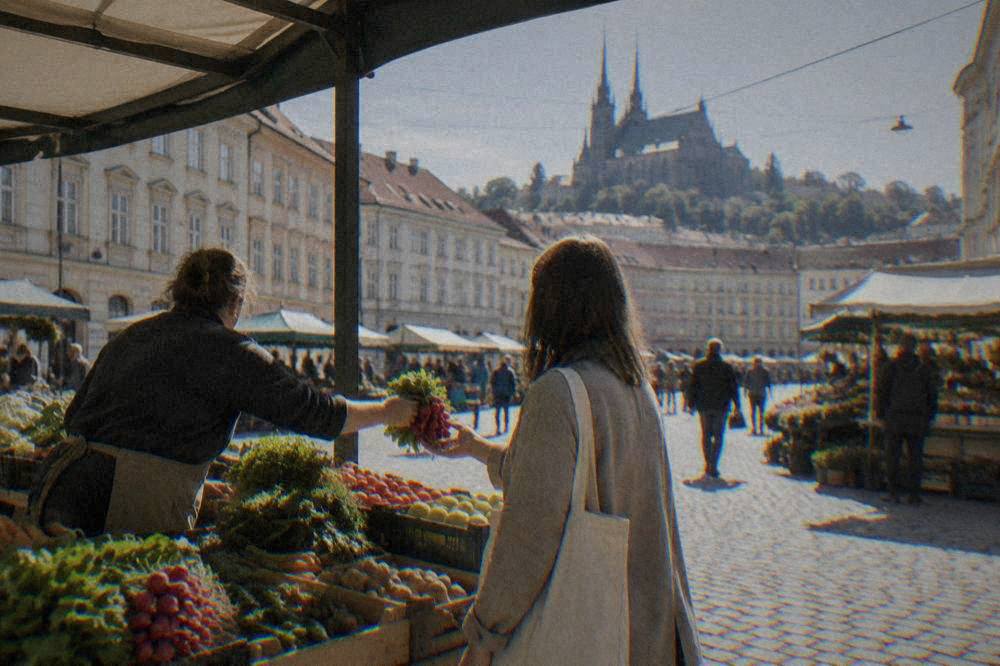
The Cabbage Market, Zelný trh, is the clearest case. It is a working market with stalls rather than tills, and every purchase begins face to face. The Old Town Hall tower sells its tickets at the tower itself, so the climb to see the Brno Dragon starts with a counter conversation. And on any guided walk, the first thing a guide hears from the group sets the register for the next hours; dobrý den, then a handshake of languages, works everywhere.
If the visit includes day trips, the same rules travel. The Moravian Karst lies about 20 km from Brno in a straight line, Mikulov about 43 km, and the vineyards of the Lednice-Valtice landscape about 46 km. Czech is the language of all of them, and dobrý den works identically in each.
Common Questions About Saying Hello In Czech
How Do You Say Hello In Czech?
Dobrý den, meaning good day, is the standard greeting. Use it with anyone you do not know. Ahoj is the informal version for friends and casual settings, and dobrý večer replaces it in the evening.
Is Ahoj Formal Or Informal?
Ahoj is strictly informal. It suits friends, family and peers in casual settings. With strangers, shop staff or anyone older, dobrý den is the correct choice, and it is never wrong in Brno.
What Does Na Shledanou Mean?
Na shledanou is the formal goodbye, used wherever dobrý den is used. Among friends, ahoj doubles as both hello and goodbye, so the same word can open and close an informal meeting.
How Do You Say Thank You In Czech?
Děkuji is thank you, and prosím covers please, here you are and you are welcome. Saying děkuji when paying or receiving anything is the everyday courtesy in Brno.
Do I Need Czech To Visit Brno?
No, but a greeting helps. Villa Tugendhat's tours run in Czech and English, guided city walks with local guides are available, and transport tickets can be bought with cards or contactless. A greeting plus prosím and děkuji covers the rest.
Does Czech Stress The First Syllable?
Yes. Czech words carry stress on the first syllable without exception, which is why dobrý den lands as DOH-bree den and the city's name sounds like BUR-no to an English ear.
One greeting, said with the stress in the right place, is the whole entry fee to Czech politeness, and in Brno it opens everything from a market stall to a castle counter. Start with dobrý den, close with na shledanou, and the language will feel like part of the visit rather than a barrier to it, a point this Brno Travel Guide page will make one last time before you go.